

Dog walking is not merely about taking a dog out for excretion, socializing, and releasing energy. Let us begin by discussing the origin of this behavior. The essence of dog walking is to simulate the cooperative behavior of our ancestors when they took dogs hunting, a practice aimed at continuing the collaboration between humans and dogs and increasing their interactions. After all, in modern society, people no longer need to herd, hunt, or even guard. People leave their homes for more than 10 hours a day for work or social gatherings, while dogs are left alone at home, languishing in boredom.
Moreover, due to the constraints of human society, dogs rarely have the opportunity to participate frequently in daily human activities. Their sole role has been reduced to companionship, devoid of any mutual tasks with their owners. Dogs have transitioned from being human partners to mere playthings, and the cooperative relationship has degenerated into a custodial relationship. Both humans and dogs no longer rely on each other, each living their separate lives—only dog walking can rebind them together.
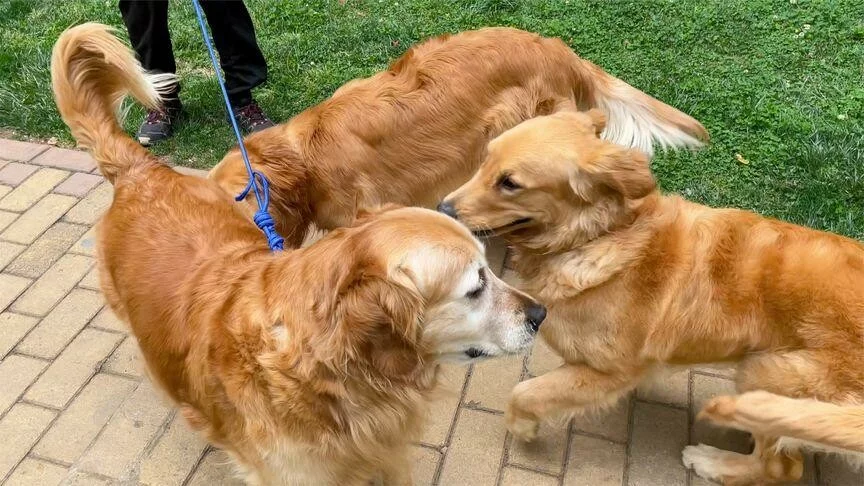
The True Purpose of Dog Walking
Enhancing Human-Dog Interaction and Bonding
Compared to simply releasing energy, socializing, or excreting, the primary purpose of dog walking is to facilitate interaction between humans and dogs, deepening their emotional bond and enhancing mutual understanding. During a walk, owners can guide the fulfillment of the dogs’physical and psychological needs while establishing and reinforcing the discipline rules of a‘small group’—thereby correcting undesirable behaviors and making dogs feel cared for and loved.

What Happens If You Don’t Walk Your Dog?
Long-Term Confinement at Home Can Lead to a Depressive State in Dogs
If you own a dog but never walk it, the dog’s experience is akin to that of a person confined at home during the pandemic—even if the house spans 200 square meters, it still amounts to imprisonment. In this respect, it is as cruel as being locked in a cage for 24 hours. In some foreign countries, neglecting to walk a dog is considered abuse, which can result in the revocation of the right to keep the dog.
A Yard Is Not a Substitute for Dog Walking
Some might say,“I have a yard; as long as the dog stays there, there’s no need to walk.”
On a smaller scale, having a yard only solves the problem of the dog excreting indoors; it does nothing for socialization or energy release.
On a larger scale, confining the dog to the yard means that apart from feeding, there is little interaction between the owner and the dog, making it impossible to correct misbehavior. There is no socialization training, which does nothing to stabilize the dog’s character.
Dogs That Dislike Going Out = Accustomed to Confinement
Others might argue,“My dog doesn’t like to go out; I hardly walk him, and nothing happens.”
Of course—your dog has simply become accustomed to being indoors. Maintaining the status quo isn’t problematic as long as you’re in charge, after all, your dog will do as you say.
Original article by KPTer, if reproduced, please cite the source: https://www.kaipet.com/en/dogs-walked-excretion-key-emotional-connection






Comments(2)
I completely agree walks are key to emotional connection! What specific activities do you find most effective for bonding with your dog?
@CriticX:We’re glad you agree! Beyond the walk itself, activities like positive reinforcement training, interactive play with toys, and even quiet cuddle time can greatly deepen your bond. We’d love to hear what activities have worked well for you and your dog!