

Cold-blooded animals, also known as poikilotherms, are animals whose body temperature changes with the external temperature. Common examples include fish like crucian carp, common carp, and sharks; amphibians like frogs, salamanders, and Chinese giant salamanders; and reptiles like geckos, lizards, and turtles—all are poikilotherms. Unlike warm-blooded animals such as humans, they cannot generate heat through their own metabolism to regulate their body temperature. Instead, they rely on the external environment, for example by sunbathing, to increase their metabolism. Therefore, being cold-blooded does not mean they are devoid of feelings; in fact, turtles have rich emotional expressions.
The “airplane legs” posture during comfort and relaxation: For colorful turtles like the red-eared slider, when they feel content, they will stretch out their hind limbs and raise them high. This is commonly known as “airplane legs” in the “turtle hobbyist community.” This posture is their signal for “I am very comfortable.” Individual personalities vary greatly; even among the same species of turtles, personalities can be vastly different.

Can Turtles Become Tame?
Yes, they can. If you raise a turtle long enough, you will find that they can establish a unique emotional bond with you through smell, sound, and movement. For instance, the Chinese pond turtle I’ve raised for 10 years can easily distinguish me from other people. When I approach, it will excitedly stretch its head out to greet me. This kind of interaction is not something a cold-blooded, emotionless animal can do.
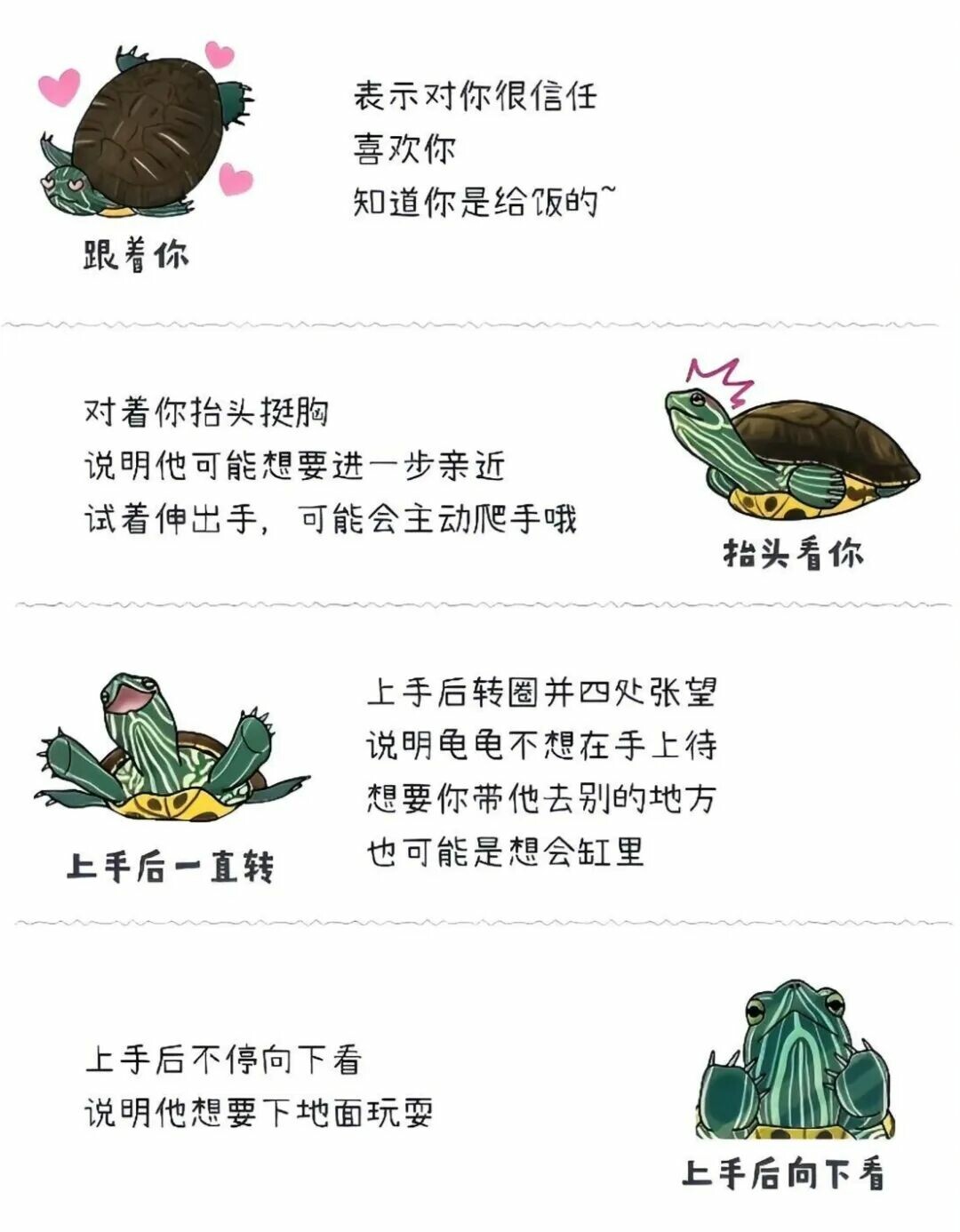
Scientific Experiments Prove Turtles Have Emotional Fluctuations
Dr. Oliver Burman’s team at the University of Lincoln in the UK conducted an interesting experiment that proved turtles experience emotional fluctuations.
The researchers placed 15 red-footed tortoises in an enclosure with two bowls, one of which contained food. After training, the tortoises all remembered which bowl had food. Later, the old bowl with food was removed, and three new bowls with no food were added. The speed at which the tortoises rushed towards the unknown bowls became the basis for judging their mood—the faster they rushed, the better their mood was considered to be, while more hesitation could indicate a low mood.
Two weeks later, these tortoises were placed in a brand-new environment. The most optimistic tortoises previously acted very composed, stretching their necks to observe their surroundings with curiosity, whereas the one with the lowest mood previously huddled in a corner.

Summary
So, stop thinking of turtles as cold-blooded, unfeeling animals. Their emotional world is far richer than we imagine. Next time you see your turtle striking the “airplane legs” pose, or pawing at something in its tank, try to pay more attention. You might just be able to read its current emotions. As long as we are willing to get closer to them, we can discover a wonderful world full of emotions and interactions.

Original article by 搬运工, if reproduced, please cite the source: https://www.kaipet.com/en/turtles-emotionless-cold-blooded-science-confirms-emotionally-rich-recognize-owners








Comments(2)
This is so fascinating! The Lincoln experiment really shows their complex emotions. I wonder if emotional expression varies much across different turtle species?
@CriticX:Hi CriticX, we’re thrilled you found the Lincoln experiment fascinating! It truly highlights turtles’ complex emotions. Your question about emotional variation across species is excellent; while individual differences are noted, exploring species-specific expressions further would be very insightful!