


Many beginners are confused about how long kitten food should be fed, and this confusion mainly stems from two aspects. First, many beginners are unclear about the definition of a kitten and how old a cat must be to be considered an adult. Second, many people are uncertain whether it is necessary to feed kitten food during the kitten stage and whether it must be fed until adulthood before switching to adult cat food.
Age Definition of Kittens and Adult Cats
Regarding the first doubt, the common belief is that cats under twelve months old are considered kittens, while cats over twelve months old are classified as adult cats. This is because most cats have essentially stopped growing and developing within twelve months, and their body size tends to stabilize. Just like humans, height usually does not increase significantly after the age of eighteen. However, some large cat breeds, such as Maine Coons, may continue to grow after twelve months, so their adulthood comes relatively later.

Feeding Suggestions for Kitten Food on the Market
Kitten food on the market typically considers cats under twelve months old as kittens in their feeding recommendations. For example, the feeding chart of Royal Canin Kitten Food suggests feeding up to twelve months, and beyond that age, they are no longer considered kittens.
Choosing Between Kitten Food and All Life Stages Cat Food
Necessity of Kitten Food
So, the second question is: Is it necessary to feed kitten food during the kitten stage?
In fact, kittens can be fed not only kitten food but also all life stages cat food. Literally, all life stages cat food is suitable for all life stages of a cat, meaning that both kittens and adult cats can consume this type of cat food. Many beginners may think there are only two types of cat food: kitten food and adult cat food. In reality, all life stages cat food is the most common, with an estimated ninety percent of cat food on the market being all life stages cat food.

Nutritional Comparison Between Kitten Food and All Life Stages Cat Food
So, for kittens, is kitten food a better choice compared to all life stages cat food?
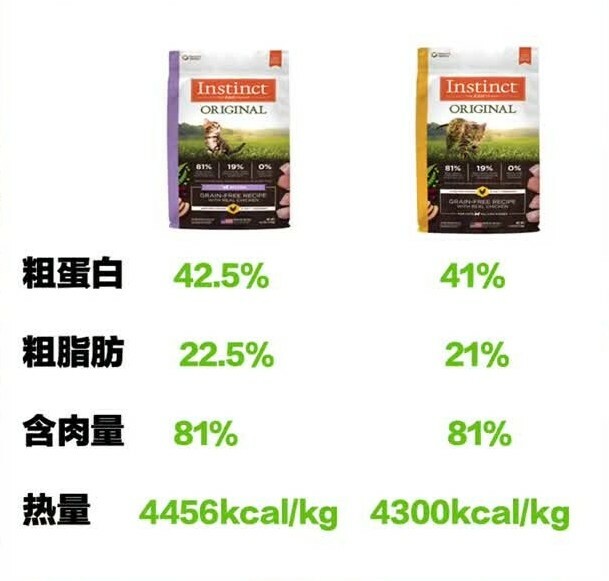
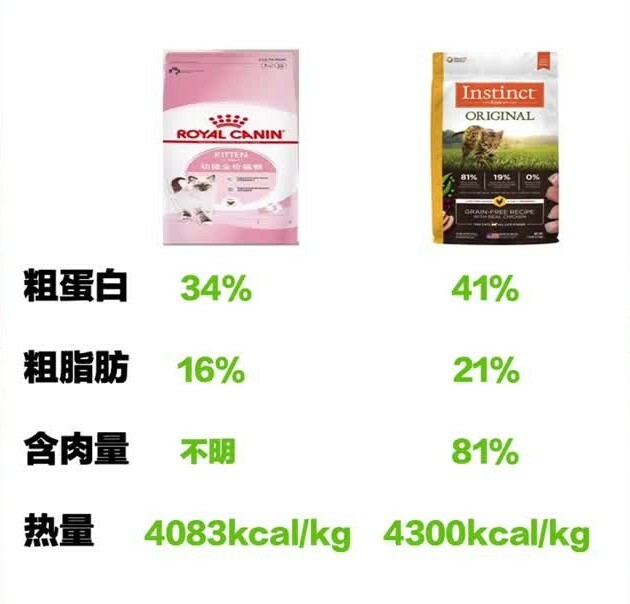
In fact, this is not the case. Many all life stages cat foods are not only inferior to kitten food but are far superior to many kitten foods. For example, when comparing Royal Canin Kitten Food with another all life stages cat food from the same brand—Royal Canin Chicken, it is found that the crude protein and crude fat of Royal Canin Kitten Food are only 1.5% higher than those of Royal Canin Chicken, with the meat content being exactly the same, and the calories are only 156 calories higher per kilogram, which is actually a very small difference.
When comparing Royal Canin Kitten Food with Royal Canin Chicken, we can see some significant differences. The crude protein content of Royal Canin Kitten Food is 34%, compared to 41% for Royal Canin Chicken, which is 7 percentage points lower. In terms of crude fat, Royal Canin Kitten Food is 16%, while Royal Canin Chicken is 21%, which is 5 percentage points lower. Additionally, the calories of Royal Canin Kitten Food are 117 calories lower than those of Royal Canin Chicken. Therefore, it can be said that Royal Canin Chicken, as an all life stages cat food, is clearly superior to Royal Canin Kitten Food in all aspects.
Final Recommendations for Feeding Kitten Food
Now, returning to the original question, I think everyone should have an answer. The kitten stage can be fed not only kitten food but also all life stages cat food, and the nutritional components of many kitten foods are even inferior to all life stages cat food. The key is to focus on these four important indicators: crude protein, crude fat, meat content, and calories. Therefore, if you initially choose kitten food, you can switch to higher-quality all life stages cat food at any time. Kitten food can be fed up to twelve months. If you initially choose all life stages cat food, you can continue feeding it, even after reaching adulthood.
Original article by KPTer, if reproduced, please cite the source: https://www.kaipet.com/en/long-kitten-food-fed-common-feeding-misconceptions








Comments(2)
Very insightful! The All Life Stages food comparison is surprising. Beyond crude percentages, how does *ingredient quality* truly affect kitten development?
@CriticX:Thank you for your insightful comment, CriticX! You’ve hit on a critical point. While our post focused on percentages, ingredient quality is indeed vital. Factors like digestibility, source, and bioavailability significantly affect a kitten’s development. We appreciate this excellent follow-up for deepening the discussion.