

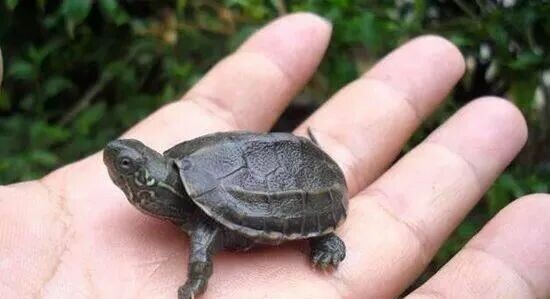
When it comes to the first turtle for a novice keeper, the vast majority start with the Chinese Pond Turtle. As one of the classic representatives of China’s native turtles, raising a Chinese Pond Turtle represents the maturation over time. For instance, in an adult male Chinese Pond Turtle’s later stages, the yellow linear patterns on its head and neck will fade, replaced by full-body melanism, making it resemble black jade—warm, lustrous, and reserved. It is for this reason that many veteran turtle keepers, after raising various species, ultimately hope to cultivate a top-grade melanistic turtle (referring to a Chinese Pond Turtle whose body has become completely black) as their final pet turtle.
Price and Barrier to Entry
One of the reasons the Chinese Pond Turtle is a beginner turtle is, first and foremost, undoubtedly its beautiful price. As the turtle species with the highest breeding output, a Chinese Pond Turtle can often be purchased for just a few yuan. In the live streams of hosts on major platforms, they are even given away as free perks. In an era where a cup of milk tea costs double digits, you can get four Chinese Pond Turtles for just 9.9 yuan. This truly gives prospective new hobbyists the idea that it’s a purchase where you can’t go wrong, prompting them to get one.
Sensitivity and Diseases
Little do they know that while the price of a Chinese Pond Turtle is moving, the keeping experience is just as ‘moving’. The Chinese Pond Turtle’s skin and shell are sensitive, making it extremely susceptible to changes in water quality. During the acclimation period, any slight fluctuation in water quality can cause the turtle to develop skin rot or shell rot. This turns every water change into a challenge of sickness. Even after the turtle is fully acclimated, the owner must remain vigilant; otherwise, the turtle might just end up floating on the water’s surface when the owner isn’t paying attention.
Basking and Calcium Issues
Then, for such a sensitive turtle, its favorite hobby is actually basking. This leads to an even greater tragedy: new keepers must also set up a basking platform (a platform for turtles to bask). Otherwise, a long-term lack of sunlight will lead to calcium deficiency, causing a soft shell condition, and the rate of shell rot will begin to skyrocket.
Poor Swimming Ability and Water Change Dilemmas
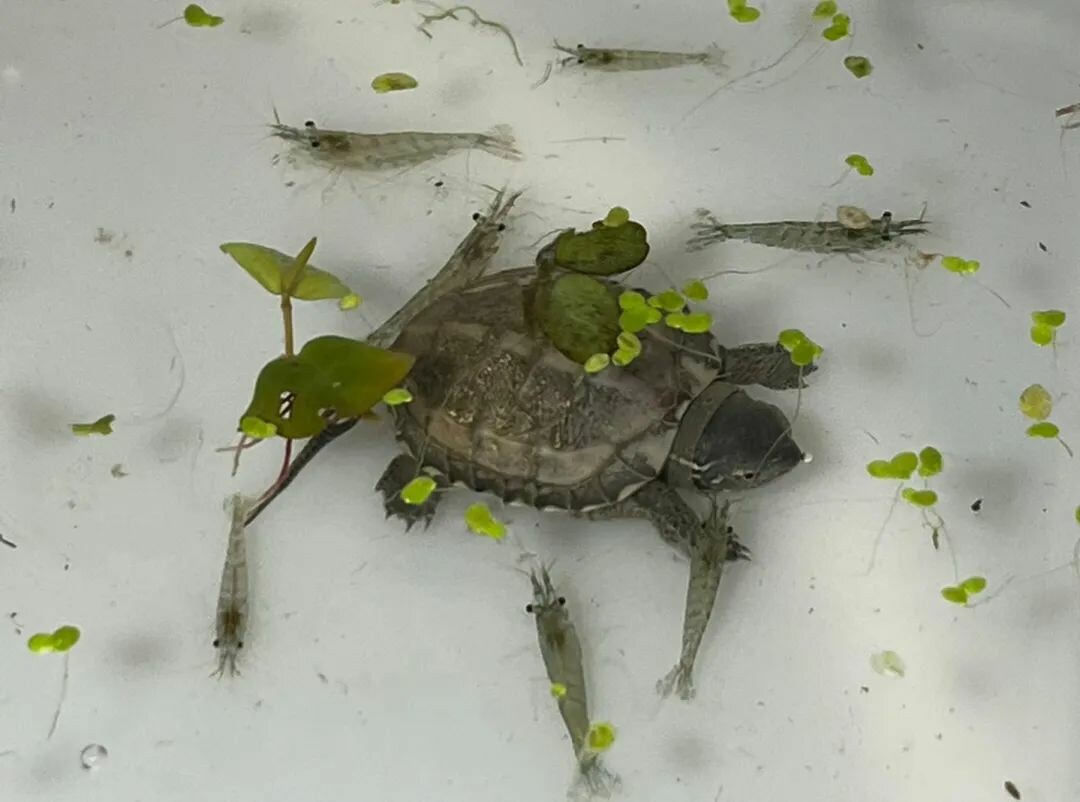
And although the Chinese Pond Turtle is the namesake of “wūguī” (turtle), it’s hard to imagine that it’s actually a representative of poor swimming ability. This traps the keeper in a vicious cycle: because of its poor swimming ability, it cannot be kept in deep water with a large volume. But not being able to use a large volume of water means the turtle’s feces and leftover food will accelerate the deterioration of water quality. This forces the owner to change the water frequently. Frequent water changes, in turn, prevent the turtle from adapting to the new water, leading to skin and shell rot. Therefore, when it comes to the turtle species that most loves to float on the water’s surface in the hobbyist circle, the Chinese Pond Turtle takes first place, and no other turtle dares to claim second.

“Gu-Style” Raising and the Bulk Selection Method
So, as the first turtle for the common keeper, the Chinese Pond Turtle both ignites the passion for turtle keeping and occasionally douses it with cold water. Consequently, the pet turtle community invented the “Gu-style” raising (a method of raising multiple individuals to select the best one) specifically for this species that loves to float on the water.
As everyone knows, the Chinese Pond Turtle is the “king of the street stalls” (an internet slang term describing something abundant and cheap), where the main appeal is that the more you buy, the better the deal. By skipping one cup of milk tea, you can get a handful of Chinese Pond Turtles; by skipping a week’s worth of milk tea, you’ll have a basin of them. Driven to madness by the turtles, keepers have opted for the “Gu-style” raising method. This involves buying 10 Chinese Pond Turtles at once to see which one has the best constitution and adaptability, to be kept as the “main” pet turtle. It has to be said that this “unorthodox method” is indeed effective quickly. Compared to keepers who have to repeatedly buy one or two more, raising them in bulk seems to be the best way out.
Challenge and Maturation
But it is precisely this difficulty in keeping them that has become one of the reasons many expert turtle keepers are keen to take on the challenge. After all, the charm of Chinese native turtles lies in their development over time. When a coin-sized hatchling, after years of your meticulous care, slowly grows up, transforming from being colorful to ultimately becoming as lustrous as jade, you have experienced the ups and downs and witnessed the turtle’s journey from being a stranger to a close companion. This is not just turtle keeping; it is also a form of self-cultivation for the keeper. What matures is not just its body color, but also our own temperament. Unaffected by honor or disgrace, watch the flowers bloom and fall before the courtyard; unconcerned with leaving or staying, gaze at the clouds rolling and unrolling in the sky.

Original article by 搬运工, if reproduced, please cite the source: https://www.kaipet.com/en/read-beginners-chinese-pond-turtles-cheap-hard-detailed-care-precautions





Comments(2)
Great post! Given the CPT’s challenges, what’s truly the easiest turtle you’d suggest for a complete beginner keeper?
@CriticX:感谢您的洞察!中华草龟确实有其挑战性。对于完全新手,我们通常推荐适应性更强的黄耳龟或某些小型麝香龟。它们是不错的入门选择,祝您养宠顺利!