An oval back shell (carapace), combined with an oval head, limbs, and a small tail—with just these few simple strokes, a lifelike turtle leaps onto the paper. But have you ever wondered what evolutionary mysteries lie hidden behind this seemingly simple turtle shell?
Knocking on a turtle’s abdomen and back, you will hear a "bang-bang" sound; this is because both the turtle’s abdomen and back are covered by a hard shell. When encountering danger, the turtle will retract its soft body into this natural "fortress" to avoid the crisis. But were the turtle’s carapace (back shell) and plastron (belly shell) produced simultaneously? If not, which part appeared first?
The Amazing Discovery of Odontochelys semitestacea
In 2008, Chinese and Canadian scholars published an important discovery in the journal Nature. They discovered an ancient turtle species living 220 million years ago in the Guanling area of Guizhou—Odontochelys semitestacea.
Unique Characteristics
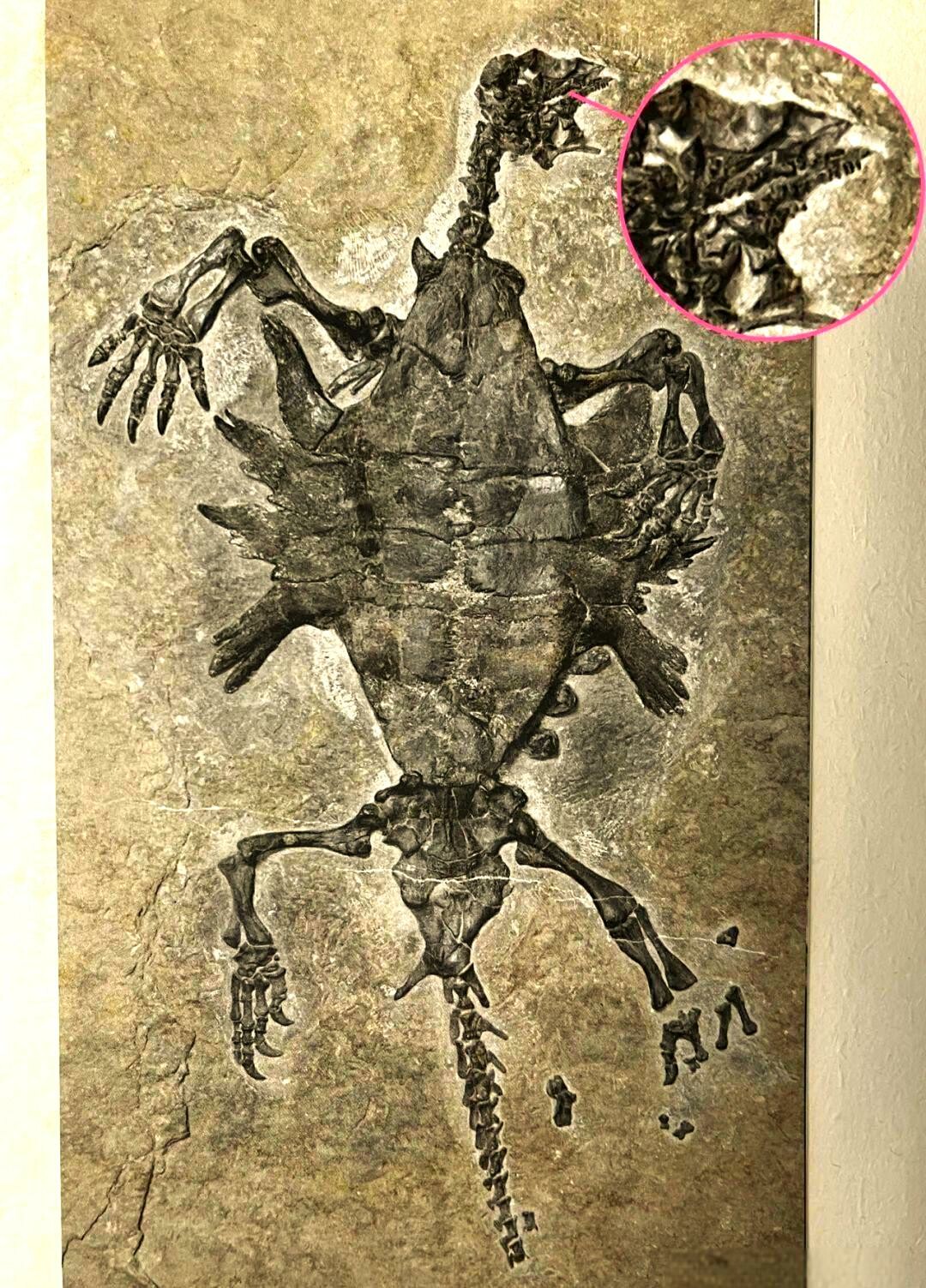
The name of this turtle reveals its 2 unique characteristics: "Half-armor" (semitestacea) means it only has half a shell, while "toothed turtle" (Odontochelys) indicates that it has teeth in its mouth, which is completely different from the beaks of modern turtles. Our current turtles have no teeth.
Revealing the Evolutionary Path
Through the study of Odontochelys semitestacea fossils, scientists discovered an interesting phenomenon: this ancient turtle species had already developed a complete plastron (belly shell), but its back only had strip-like ribs and had not yet formed a carapace. This discovery indicates that the evolution of the turtle shell began with the plastron. Interestingly, the embryonic development process of modern turtles also follows this sequence: growing the plastron first, and the carapace later.
Reasons for the Priority Evolution of the Plastron
So, why did Odontochelys semitestacea grow a plastron first? The members of the Guanling Biota (a fossil group in the Guanling area of Guizhou, China) were mostly marine organisms, and Odontochelys semitestacea was no exception.
Scientists believe that in aquatic environments, attacks from below are far more common than attacks from above. This is also reflected in fish; the abdomens of most fish are white, which is a form of protective coloration that helps them blend in with the hues above—when looking up, they cannot be seen clearly—allowing them to evade predators.
However, the ancestors of turtles chose a different strategy. The ancestors of turtles did not try to deceive predators through camouflage, but instead developed a hard plastron, providing active defense for the abdomen. Through comparison with modern turtles and soft-shelled turtles, researchers believe that the aquatic level of Odontochelys semitestacea was comparable to that of modern soft-shelled turtles.
Important Clues for Evolutionary Research
The discovery of Odontochelys semitestacea provides important clues for us to understand the evolution of turtles.
Original article by 搬运工, if reproduced, please cite the source: https://www.kaipet.com/en/odontochelys-semitestacea-toothed-half-shelled-revealing-evolutionary-history-turtle-shells