

Get to know a turtle species a day. Today, we introduce the Golden Coin Turtle. Just from its name, you know this turtle exudes the “scent” of money.
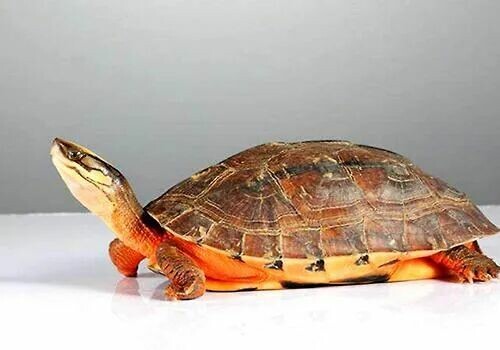
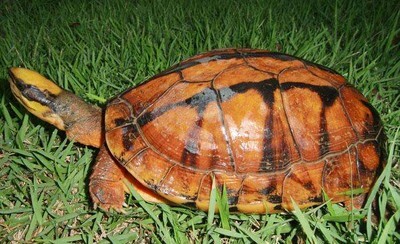
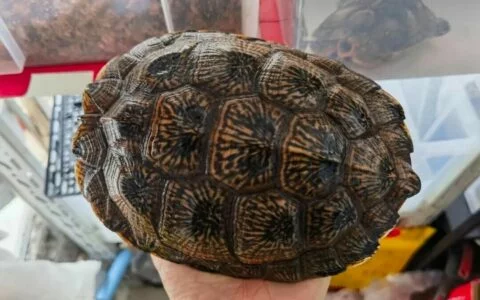
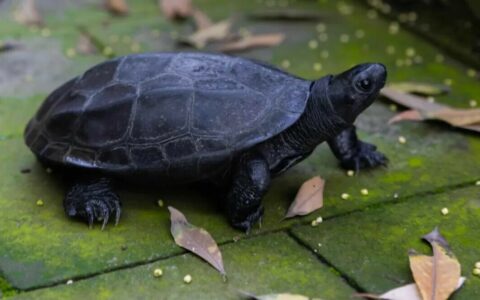
The scientific name for the Golden Coin Turtle is the three-lined box turtle (Cuora trifasciata). It gets its name from its reddish-brown or brown carapace, which features 3 distinct black longitudinal stripes. The central stripe on the carapace is broad and rounded, while the ones on the sides are less prominent, resembling the Chinese character “川 ” (chuān), hence it is also called the “‘Chuan’Character Turtle”. Its plastron is black with yellow edges, and there is 1 long black stripe on the bridge. The top of its head is waxy yellow, in sharp contrast to the black on the sides of its head, with a reddish-brown oval spot inlaid behind the eye. Its limbs are relatively flat, with fully webbed fingers and toes, and it has a short tail. Males have a narrower carapace and a thicker, longer tail, while females have a wider carapace and a thinner, shorter tail.
Geographical Distribution and Morphological Differences of the Golden Coin Turtle
It is worth mentioning that the Golden Coin Turtle is mainly distributed in subtropical regions such as the southern Chinese provinces of Guangdong, Guangxi, Fujian, and Hainan, as well as countries like Vietnam and Laos. This has led to morphological differences among the Golden Coin Turtles from these different regions.
For example, the Chinese Hainan variety of Golden Coin Turtle has a narrow, high carapace that is brownish-yellow or yellow. The Guangdong variety is larger with a wider carapace and a relatively darker color. The Vietnamese variety has a wide, flat carapace that is reddish-brown or light brown, with a more vibrant luster.
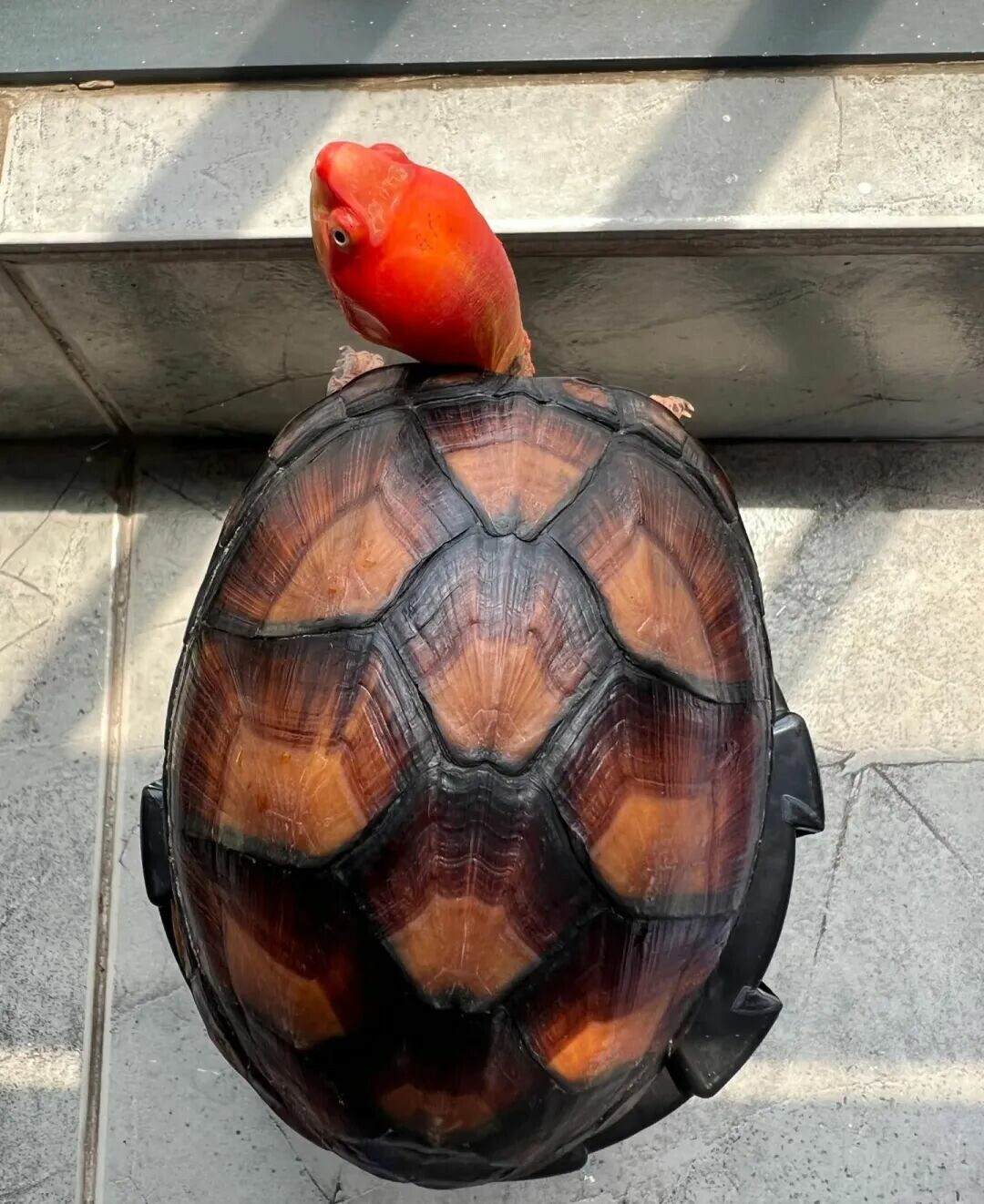
As for the head features, the Chinese Hainan and Guangdong varieties have a golden-yellow or waxy-yellow crown, wide black bands on the sides of the head, and a blunter snout. The Vietnamese variety has an olive-green or entirely cyan crown, narrower black bands on the sides of the head, and a sharper snout. In terms of body color, the differences are also quite significant. The Chinese Golden Coin Turtle’s lower jaw, neck, and inner limbs are yellow or light yellow, and its flesh is not red. The Vietnamese variety has an orange-red lower jaw, neck, and inner limbs, and its flesh is very red.
Disparity in Market Prices

Due to these morphological differences, the prices between them are worlds apart. For instance, a single Vietnamese Golden Coin Turtle can fetch a price of over 20,000 yuan, and a mature breeding male can cost over 300,000 yuan. In contrast, a single Golden Coin Turtle from areas like Hainan, China, costs only a few thousand yuan, showing the vast difference.
But these are just the current market prices. Back before the turtle-keeping community became widely popular, the price of the Golden Coin Turtle was hyped up to an astronomical level, with hatchlings costing tens of thousands of yuan, and some with special appearance quality even reaching a million yuan. Among buyers, wealthy businessmen from Guangdong were particularly fond of the Golden Coin Turtle.
Cultural Symbolism and the “New Five Major Items”
The name of the Golden Coin Turtle (金钱龟, Jīnqián guī) itself contains the characters for “gold” and “money”. In Cantonese, the pronunciation of “three-lined turtle” (sām sin gwāi) is very close to “money-generating turtle” (sāang chín gwāi), carrying the auspicious meaning of “money comes back” and expressing people’s hope for wealth to flow in. At the same time, the turtle is a symbol of longevity in traditional culture. Guangdong businessmen hope that by raising Golden Coin Turtles, their businesses will prosper for a long time and they will enjoy good health and longevity. Furthermore, Feng Shui culture is prevalent in the Guangdong region. After the Hong Kong custom of keeping Golden Coin Turtles to ward off evil spirits and strengthen the fire element fortune spread to the Pearl River Delta, Guangdong businessmen also came to regard them as Feng Shui treasures, believing it can ward off evil and bring good luck to their families and businesses.
The Golden Coin Turtle is expensive, and raising them requires significant financial means. Therefore, the Golden Coin Turtle has become a “new favorite” in the circles of the wealthy in Guangdong, and is known, along with villas, Podocarpus pines, Koi fish, and Osmanthus, as the “New Five Major Items” of Guangdong’s wealthy. In business and social occasions, the Golden Coin Turtle is also often used as a high-end gift or for hospitality. For instance, some hotels in Shenzhen offer an astronomically priced Golden Coin Turtle soup to demonstrate the high standard of reception. Owning and displaying a Golden Coin Turtle can showcase a businessman’s wealth and status.
Legendary Figure Who Got Rich from Turtle Farming
So, has anyone actually built a fortune from Golden Coin Turtles?
Indeed, there is. That would be the legendary figure in the turtle-keeping world—Li Yi. In his early years, Li Yi borrowed 2,745 yuan to buy 8 Golden Coin Turtles. Later, as the market price for Golden Coin Turtles soared, he gradually established a population of them through breeding. He can be described as a typical “golden turtle son-in-law” (a wealthy husband).
Original article by 搬运工, if reproduced, please cite the source: https://www.kaipet.com/en/golden-coin-turtle-morphology-regional-differences-cultural-symbolism



Comments(2)
I’m amazed by the vast price difference between varieties! Besides morphology, what other factors drive this market disparity?
@CriticX:That’s a great question! Beyond morphology, cultural symbolism, auspicious meanings, Feng Shui beliefs, and its role as a status symbol among wealthy collectors, particularly in Guangdong, significantly drive the market disparity and high prices.