

At 3 AM, I received an urgent call. My friend’s Lutino Cockatiel, “Dou Dou,”had collapsed at the bottom of the cage, panting heavily, its claws gripping the perch for dear life. We rushed to the emergency room for X-rays, oxygen, and nebulization, struggling until dawn. The doctor took off his stethoscope and the first thing he asked wasn’t “What did you feed it?” but rather: “How long has it been since the cage was thoroughly washed?”
He froze for a moment, stammering, “I change the tray every day……”
The doctor shook his head and handed over an X-ray showing cloudy opacities in the lungs. “Bacterial pneumonia. Under the cage grate, in the blind spots of the food bowls, inside the cracks of the toys—these are all ‘time bombs’you can’t see.”
This is not an isolated case. In my more than 10 years in the industry, the phrase I say most often to bird owners isn’t “here’s how to take this medicine,” but “go back and scrub the cage clean first.”
You change the water and add food every day, thinking that’s “clean.”But you might not know that a seemingly “okay” bird cage can have an internal bacterial density 5 to 10 times higher than your toilet seat.
Today, we aren’t talking about sentimentality; we are talking strictly about “hardcore cleaning.”This is the ultimate cleaning guide to help your feathered treasure say goodbye to life in a “Petri dish.”
Why Be So “Meticulous”? — The “Biohazard” Behind Cleaning
The Respiratory Tract: A Fragile Air Filter
The avian respiratory system is extremely precise and efficient, but this also means it is defenseless against impurities in the air. The dropping of a single feather can kick up a cloud of dust in the cage that you cannot see.
Aspergillus: The warm, damp bottom of the cage is its paradise. Once spores are inhaled, they take root in the Air Sacs and lungs, leading to fatal “Aspergillosis.” The symptoms? By the time you notice the parrot gasping, the lungs are often already full of fungal growth.
Chlamydia psittaci (Parrot Fever): Hides in the dust of dried feces. It is zoonotic, meaning it causes severe damage to both humans and birds.
Cleaning Agent Volatiles: What smells just “a little fragrant” to you is a toxic gas to birds that directly burns their respiratory mucosa.

The Digestive Tract: Precision Sniping via “Ingested Pathogens”
Do you think there’s only millet in the food bowl?
Spoiled Food Residue: Moist fruit pieces and soaked pellets can breed massive amounts of bacteria (especially E. coli and Salmonella) within hours in a warm environment, sticking to the bowl walls. Every time the bird pecks, it is “tasting” a bacterial salad.
“Biofilm” in Water Dispensers: That seemingly clear water bottle with the ball bearing—if you don’t take it apart and scrub it, a slimy layer (biofilm) will form inside the nozzle and tube. That is a luxury apartment for various microorganisms. Every sip of water the bird takes is swallowing a miniature colony of bacteria.
Claws & Skin: 365 Days of Non-Stop Intimate Contact
What do a bird’s claws hold onto all day? The perch. What is on the perch? A mixture of dried feces, food oils, and dander.
Bacterial Dermatitis / Foot Infection (Pododermatitis/Bumblefoot): Prolonged contact with filth leads to swelling, scabbing, and infection of the claws; in severe cases, toe amputation is required.
Mites and Feather Lice: Damp, dirty cracks are hotbeds for parasites. They come out at night to suck blood, causing the parrot to become irritable, anemic, and pluck its feathers.
To summarize in one sentence: To a bird, an unclean cage is a “full-spectrum health attack system” that operates 24 hours a day.
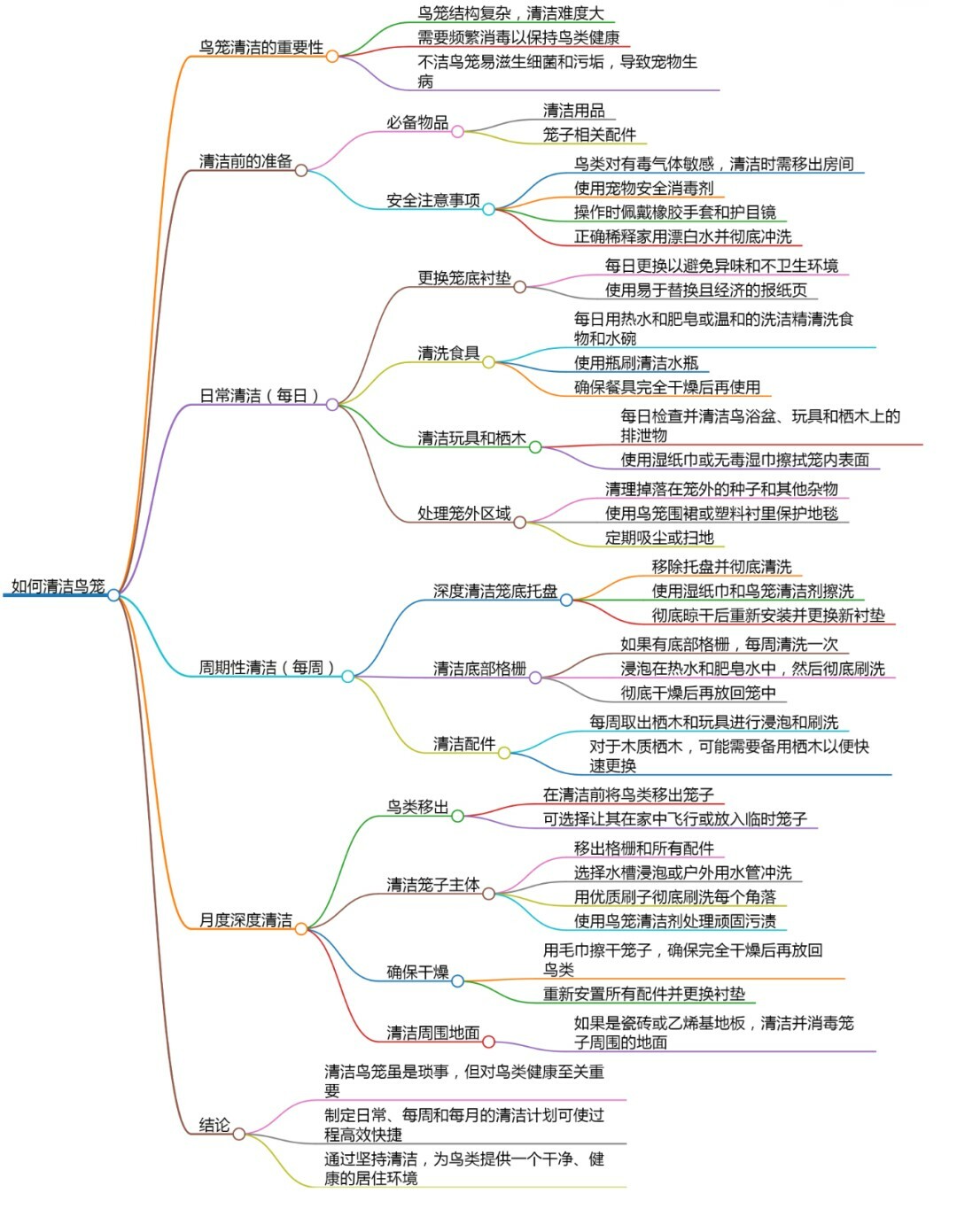
The “Three-Layer Defense” Cleaning Method — Building a Sterile Fortress from Daily to Deep Clean
Stop speaking vaguely about “washing the cage.” Scientific cleaning must be a layered, targeted operational system.
Daily Defense (5 Minutes, Sniping Surface Threats)
This is the baseline; this is the air they breathe.
Morning Inspection (1 Minute)
Check Water: Has food or feces mixed in? Change it all immediately.
Check Food: Are fruits or vegetables spoiled? Remove immediately.
Check Perches: Are there obvious poop clumps? Wipe them off with a wet wipe.
The Tray Revolution (2 Minutes)
Throw away old liners (don’t use dusty newspapers; use pet-specific liners or ink-free leaflets).
Key Action: Use diluted white vinegar water (1:1) or pet disinfectant wipes to wipe the cage bottom frame above the tray. This is a “buffer zone” for fecal debris and is most easily overlooked.
“Soul Cleansing” of Food & Water Bowls (2 Minutes)
Don’t just rinse! Use a sponge or bottle brush with hot water and mild dish soap to scrub inside and out, corners, and threads.
Must wipe dry or air dry before putting them back! Moisture is the root of all evil.
Weekly Siege (30 Minutes, Dismantling Enemy Strongholds)
Choose a weekend morning when the bird is in good condition.
“The Great Evacuation” & “The Big Teardown”
Move the parrot to a safe spare cage or carrier (get it used to this usually!).
Remove everything: Perches, toys, food bowls, water bottles, bottom grates.
Material-Based Personalized “Interrogation”
Plastic / Metal Parts (Bowls, Toys): Soak in hot water mixed with bird-safe disinfectant (like F10 SC, Avisafe) for 15 minutes. Use an old toothbrush to scrub every crevice.
Wooden Perches (Disaster Zones!): Scrub the surface with hot water, then use coarse sandpaper to gently sand off the outermost layer of grime. This is the only way to eradicate bacteria that have seeped into the wood fibers. Dry thoroughly in the sun (at least half a day) or blow dry with a hairdryer. Keep several spares to rotate usage.
Bottom Grate: The dirtiest part, bar none. Use a stiff-bristled brush to scrub every grid line repeatedly under running water. Check for rust (which can cause heavy metal poisoning).
Cage Body Wipe Down
Spray diluted disinfectant on the cage wires and corners using a spray bottle, and let it sit for 10 minutes.
Wipe from top to bottom with a cloth. Don’t forget the top of the cage!
Monthly Annihilation (2 Hours, The General Assault)
Pick a day with clear skies; this is the ritual of the “Deep Clean.”
Bathroom War Room
Move the empty cage body (large cages can have their tops removed) into the shower or onto the balcony.
Use a showerhead or hose to thoroughly flush from the inside out with warm water. Water pressure can wash away stubborn debris.
Deep Disinfection & “Sunlight Therapy”
After rinsing, spray disinfectant and leave it on for a longer time (15-20 minutes).
The most crucial step: Sunbathing! Place all cage parts in a ventilated area with direct sunlight to dry completely. UV rays are the best natural disinfectant, with zero chemical residue. This process takes at least 3-4 hours to ensure every crevice is dry.
Environmental Disinfection
Mop the floor and wipe the walls where the cage is positioned using disinfectant.
Check nearby for air conditioner vents (avoid direct drafts) and potted plants (to prevent mold spores).
Arsenal and Red Lines — What to Use and What Not to Use
Your Weapon List
Physical Class
Various Brushes: Stiff brush (for the bottom grate), bottle brush (for water bottles), old toothbrush (for crevices).
Sandpaper: The artifact for treating wooden perches.
Rags and Paper Towels: It is best to use disposable kitchen towels to avoid cross-contamination.
Chemical Class (Choose Carefully!)
Top Choice: Avian/Pet-specific disinfectants (such as F10 SC, Avisafe). Dilute according to instructions; relatively safe for birds.
Second Choice: Household bleach. Must be strictly diluted at a ratio of 1:99 or lower (10ml bleach to 990ml water). After disinfecting, you must rinse repeatedly and thoroughly with clean water until there is absolutely no smell of chlorine. Corrosive to metals.
Natural Class
White Vinegar Solution (1:1): Good for daily wiping and descaling, but has limited bactericidal power.
Absolute Red Lines! Don’t Even Touch These “Poisons”!
Strong household disinfectants like chlorine bleach brands (e.g., “84”) or phenolic disinfectants (e.g., Dettol, Walch): The phenols and aldehydes they contain are highly toxic to birds! Even the volatile fumes can cause pulmonary edema and death.
Any Air Fresheners, Aromatherapy, or Perfumes: A bird’s respiratory tract cannot tolerate any artificial fragrances.
Laundry Powder, Undiluted Dish Soap: Residue that isn’t rinsed off will poison the parrot if pecked.
Steel Wool: Will leave scratches on metal surfaces, becoming permanent shelters for bacteria.
Life-Saving Operational Rules
Ventilation! Ventilation! Ventilation! When cleaning, the bird must be in another room. After cleaning, wait for all odors to dissipate (at least 2-3 hours) and the cage to be completely dry before inviting the “master” back to the palace.
Wear Gloves and a Mask: Protect yourself and prevent bacteria on your hands from contaminating the cleaned environment.
Observe, Don’t Just Complete: Cleaning is also an excellent opportunity for a “physical exam.”Check if feces are abnormal, if feathers are falling out, if there is blood on the perch, or if cage wires are damaged or paint is peeling. This information tells you your parrot’s status sooner than any instrument.
Cleaning is Also a Form of Love and Companionship
I know, reading this, you might feel: “This is too much trouble; raising a bird is more tiring than raising a child.”
But think about it from another angle: Those 5 minutes every day are your exclusive time to focus on observing if it’s doing well or being mischievous. Those 30 minutes every week are the ritual where you personally build a safe palace for it. Those 2 hours every month are a quiet afternoon where you and it wait together in the sunshine for a fresh start.
True love is not admiring it locked in a magnificent prison, but brushing away every speck of dust for it, clearing out the hidden dangers in every corner, and allowing it to truly groom its feathers and sing with health and peace of mind in its own square inch of the world.

Starting tonight, when you walk towards the bird cage, don’t just see a little bird. Please see the entire micro-world it relies on for survival. And your hands are the guardian gods of that world.
Cleanliness is the most basic, yet most expensive gift you can give it.
(Easter Egg: Cleaning Checklist)
- Is the inside of the water bottle scrubbed?
- Are the corners of the food bowl wiped?
- Are fecal stains on the perch sanded off?
- Are the grids of the bottom grate clear?
- Has the disinfectant smell dissipated?
- Is the cage thoroughly dry?
- Is the boss safely back home?
Every checkmark adds another layer of insurance to its life.
Original article by 搬运工, if reproduced, please cite the source: https://www.kaipet.com/en/deep-cleaning-methods-bird-cages-refuse-petri-dish-3-steps-prevent-avian-diseases



Comments(1)
This deep cleaning guide is fantastic! For monthly sunbathing, what’s your best tip for ensuring everything dries completely?