

This article mainly covers the principles to follow when choosing food for birds and what foods birds prefer.
Principles of Food Selection
A parrot’s daily food intake is approximately 4% to 10% of its body weight; significantly more or less than this range may indicate a problem. The principles for a healthy parrot diet are similar to those for a healthy human diet. Only moderate adjustments based on what parrots eat are required.
Composition
An ideal parrot diet should consist of multiple modules, with different proportions for different species. Within this proportional range, owners can slowly figure out the ratio suitable for their own birds.
Formulated diets — 30% (as snacks) ~ 70% (as staple food)
Seed diets — 30% (as snacks) ~ 50% (as staple food)
Vegetables — 10% ~ 30%
Fruits — 10% ~ 20%
Nuts / Bird treats / Coarse grains — 5% ~ 10%

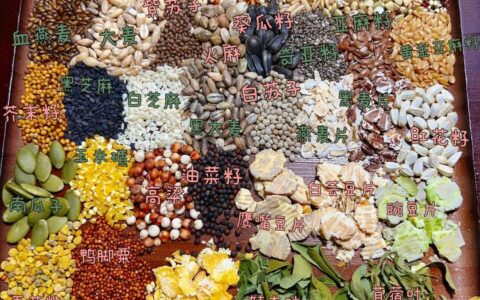
Seed diets and pellets (a type of nutritionally balanced granular feed for birds) each have their benefits. Seed diets have better palatability, while pellets are more nutritionally comprehensive and easier to digest. Of course, conversely, seed diets easily make birds picky eaters, while birds might adamantly refuse to eat even a single bite of pellets.
So the overall ratios are here, and you can choose the combination freely. Of course, if the parrot accepts both types of food, pellets are a more suitable choice during illness or for older birds.
I personally prefer seed diets, although they can be quite picky eaters.
Principle of Food Diversity
Parrots’ food should be as diverse as possible, and parrots should be exposed to a variety of foods early in the weaning stage.
“Diversity” here refers more to the comprehensiveness of nutrients, but it also encompasses a diverse selection of textures and tastes.
The richness of texture and taste requires a mixture of various bird foods. Traditional mixed seed diets meet parrots’ multiple needs for grain texture and taste relatively well. However, the disadvantage of the pure pellet diet advocated by many merchants nowadays is that it forces parrots into a monotonous diet.
A parrot’s taste preferences will change with its physical condition and changes in the surrounding environment. Therefore, we should provide them with rich and diverse foods and more innovative combinations of food types.
In this process, many owners will encounter:
My bird has eaten such-and-such food since it was little. Now I feed it such-and-such food and it doesn’t like it; it would rather starve to death than eat this. What should I do?
And similar questions. This situation is generally because these birds were raised in an environment with a relatively monotonous diet, so their tolerance for unfamiliar foods is low.
For such birds, we must also actively provide a variety of foods, allowing them to gradually make contact with and cultivate their habits. We can also re-process food to meet their needs for different food colors and textures. For example, soaking pellets in hot water to soften them or crushing them into small granules more suitable for parrots to chew. In these matters, different birds will have different preferences; some prefer smooth granules while others like chewing on crunchy things.
Separation of Dry and Wet Food
Food is divided into dry food and wet food according to water content.
Dry seeds, nuts, pellets, etc., are classified as dry food; dried vegetables and dried fruits can also be classified in this category. Fresh melons, fruits, and vegetables, softened pellets, and “chop” (a type of bird food made by chopping and mixing various vegetables and fruits) that many owners like to make for their birds are included in wet food.
When placing food, dry food and wet food need to be placed in two separate feeders. Dry food can be left in the feeder for a relatively long time; you only need to blow off the husks / add food daily. Wet food needs to be kept fresh. It needs to be replaced or discarded after at most 4 hours. Therefore, dry food can be provided during the day, while wet food can be added in the evening, allowing them to finish it as soon as possible.
Parrots’ Food Preferences
Seed Diets vs. Formulated Diets
They lean more towards seed diets, but some birds are more inclined to eat formulated diets, and some birds like to eat processed formulated diets.
Fruits and Vegetables
Based on my experience, they prefer crunchy vegetables and soft, sweet fruits. For example, Chinese cabbage stalks and ripe mangoes.
Popular Pellet Types
Compared to seed diets, pellets are a relatively monotonous and boring food; for birds, the texture is not as varied as seed diets. It is recommended to mix various pellets together for birds to eat, or mix pellets with the fruits and vegetables they love to make chop, thereby improving acceptance.
There is also a small tip: do not choose pellets containing artificial colors (pigments). Pigments in food can cause discoloration of feces. Although this is not pathological discoloration, if the physical condition is poor at the same time, this discoloration can cause misdiagnosis.
Original article by 搬运工, if reproduced, please cite the source: https://www.kaipet.com/en/parrot-feeding-guide-3-major-principles-scientifically-balanced-diet



Comments(1)
Great guide! I’m curious, what are some effective ways to make nutritionally complete pellets more appealing to picky parrots?