

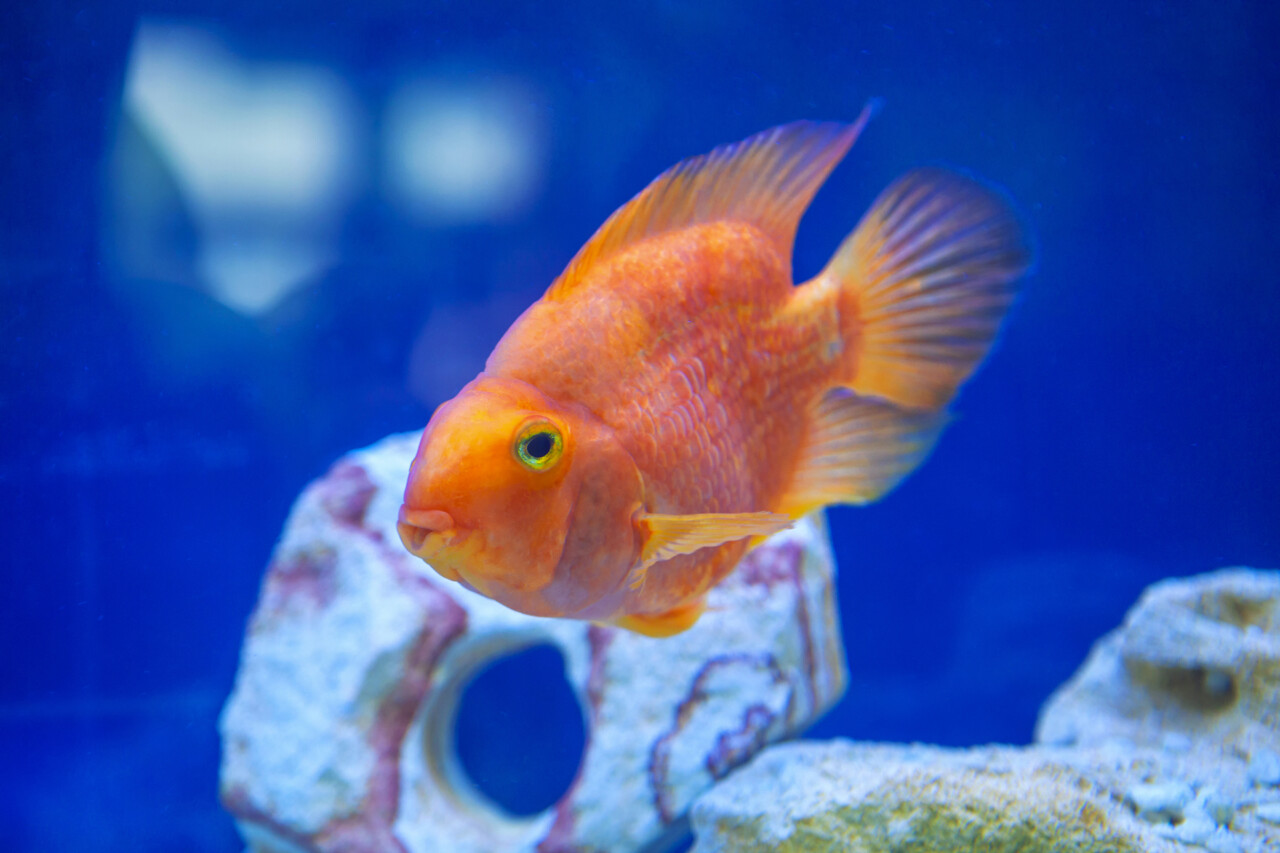
Parrot cichlids are warm-blooded animals, and their body temperature changes with the temperature of the aquarium water, making them highly sensitive to temperature variations. If the water temperature is too low, it may cause the fish to lose appetite, exhibit lethargy, or develop various other diseases. Conversely, if the water temperature is too high, the fish’s vitality and appetite may decrease, leading to a series of other problems.
Ideal Temperature Range
The optimal water temperature should be maintained between 26°C and 30°C. Personally, I recommend that for parrot cichlids with a body length under 23 cm, the water temperature should be kept at 30°C. For parrot cichlids with a body length between 23 cm and 27 cm, the water temperature should be maintained at 29°C. For parrot cichlids with a body length over 27 cm, the water temperature should be set at 28°C.
Water Temperature Recommendations for Parrot Cichlids of Different Sizes
- Parrot cichlids under 23 cm: Maintain water temperature at 30°C.
- Parrot cichlids between 23 cm and 27 cm: Maintain water temperature at 29°C.
- Parrot cichlids over 27 cm: Maintain water temperature at 28°C.
Why Do Parrot Cichlids of Different Sizes Require Different Water Temperatures?
This is because various factors such as the cichlid’s coloration, disease resistance, growth rate, metabolism, immunity, and lifespan all depend on the water temperature. Based on these aspects, it is recommended to use different water temperatures for different sizes of parrot cichlids. I may write a detailed article in the future to explain these aspects further.
Original article by KPTer, if reproduced, please cite the source: https://www.kaipet.com/en/optimal-water-temperature-parrot-cichlids-temperature-control-methods-body-sizes



Comments(2)
Great tips on parrot cichlid temperatures! I’m curious, how quickly do temperature changes affect their coloration or disease resistance?
@CriticX:Thanks for the great question, CriticX! The article notes temperature impacts coloration and disease resistance, and the author mentioned possibly elaborating in a future post. We appreciate your engagement and encourage others to share insights!