

Get to know a turtle a day. Today, we’ll introduce one of the favorites among turtle hobbyists: the Alligator Snapping Turtle.
Introduction to the Alligator Snapping Turtle
The Alligator Snapping Turtle is a species of snapping turtle. Among turtle hobbyists, the most common ones are the Florida Snapping Turtle and the Hybrid Florida Snapper. They are inexpensive, often available for just dozens of yuan. But Lao Wu says privately that, in fact, most sellers like to call Hybrid Florida Snappers “Purebred Florida Snappers” to sell to hobbyists, and many friends are known to have been deceived. As for the North American Snapping Turtle, it has nearly become representative of meat turtles, since for a similar price, the Hybrid Florida Snapper offers more hobby value.
Meanwhile, the Alligator Snapping Turtle, with its more domineering appearance, ranks above the other two. Its hatchlings are often priced in the several hundred yuan range, yet they remain incredibly popular. As usual, we’ll first briefly introduce the appearance of the Alligator Snapping Turtle, and at the end of the article, we will share methods for selecting a quality one.
Appearance and Size of the Alligator Snapping Turtle
The Alligator Snapping Turtle is one of the world’s largest freshwater turtles. The carapace length of an adult can reach 40-70 cm, with a weight of 45-75 kg; the largest can reach 200 kg, with a body length of 75-90 cm. The carapace is long and thick, brownish-tan or brownish-black, with 3 prominent longitudinal ridges. The 13 scutes are arranged in 3 rows, resembling a continuous range of 13 small mountains. The edge of the carapace has many saw-toothed protrusions. The head is triangular and cannot be fully retracted into the shell. Its gape is large, extending to behind the eyes. The eyes are small but alert, surrounded by scattered yellow markings, and have star-shaped fleshy “eyelashes.” On its tongue, there is a bright red, forked, worm-like fleshy lure used to attract fish. Its four limbs are thick and powerful, with sharp, curved claws and webbed toes. The tail is thin and long, as hard as a steel whip, about half the length of the carapace, and is covered with ring-like scales, forming spines on its dorsal side.

From its appearance and size, we know that the adult Alligator Snapping Turtle will be given up on by most home hobbyists due to its size. Yet, this snapping turtle, which is expensive on the market and has low interactivity, has become a favorite of many turtle hobbyists.
The Charm and Physical Characteristics of the Alligator Snapping Turtle
The biggest reason is undoubtedly the Alligator Snapping Turtle’s appearance and its matching imposing presence. From the hatchling stage, the shell shape and head of an Alligator Snapper already have the characteristics of a fierce beast. When it reaches the sub-adult stage, Lao Wu would call this the peak of its appearance. Although it is still relatively small at this time, its savage, eagle-beaked giant head and the sharp, glossy black dorsal ridges lack the aged look of later years, resembling a keen and enterprising youth, with everything appearing vigorous and powerful.
And with such a domineering appearance, it’s natural that merchants assign various price tiers to them. Today, terms like “Yán quán,” “Pǔ quán,” “Dān zēng,” and “Shuāng zēng” likely make interested hobbyists’ heads spin. Lao Wu will also explain the meanings of these common terms.

As shown in the picture is a 3:3 “Yán quán” Alligator Snapping Turtle, meaning it has three symmetrical marginal scutes on each side. Currently, there are also Alligator Snappers with 5:5, 4:4, and even 2:2 marginal scute counts on the market. However, it should be noted that 3:3 is the standard scute pattern for this species. Apart from the naming gimmicks created by sellers, in other turtle species, these variations would be considered symmetrical scute anomalies.
The term “Pǔ quán” actually refers to a complete scute anomaly, but sellers have created a fancy name for it. It means the number of marginal scutes on each side does not match, for example, 4:3 or 3:2, with more on one side than the other.
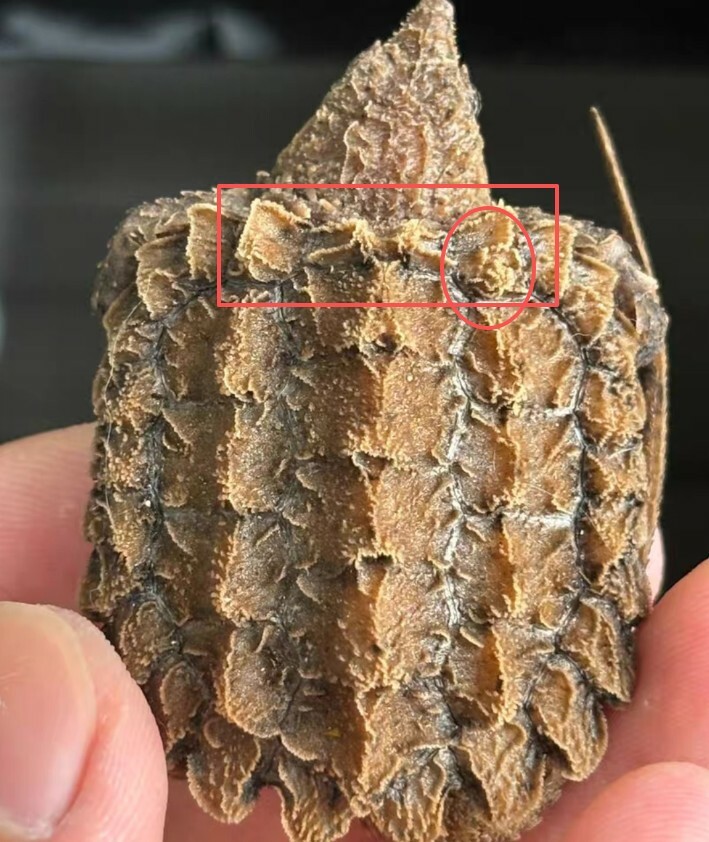
“Dān zēng” and “Shuāng zēng” refer to an extra scute appearing on the upper marginal scutes of the Alligator Snapping Turtle. An extra scute on one side is called “Dān zēng” (Single Extra), while extra scutes on both sides are called “Shuāng zēng” (Double Extra).
These are common terms used by sellers for Alligator Snapping Turtles and are also points to pay attention to when selecting a hatchling. The priority is to choose a hatchling with 3:3 symmetrical marginal scutes and no extra growth. If you prefer uniqueness, you should still choose one with a symmetrical number of marginal scutes on both sides to ensure a perfect body shape after it becomes a sub-adult. Additionally, you should also check for scute anomalies in other areas of the shell, such as around the dorsal ridges, and whether the tail is intact. The tail of an Alligator Snapping Turtle is prone to abrasion or fracture in the early stages; if it is bent and cannot be straightened, it may later become necrotic and fall off. When selecting a specimen, the tail should be long, straight, and unbroken. An Alligator Snapping Turtle has four barbels under its mouth. When selecting, check if the barbels are intact. However, the barbels are easily worn down, are not regenerative, and may also fall off after being raised, so there is no need to be overly concerned about it.
Original article by 搬运工, if reproduced, please cite the source: https://www.kaipet.com/en/buyers-guide-alligator-snapping-turtles-select-healthy-symmetrical-hatchlings








Comments(2)
This guide on selecting hatchlings is really useful! I’m curious, beyond scute patterns, what other health signs should new owners monitor in young ASTs?
@CriticX:感谢您的提问!除了文中提到的甲壳特征,新手饲主还应关注幼龟的活跃度、眼睛是否清澈、食欲及排泄是否正常。这些都是判断其整体健康的重要指标。