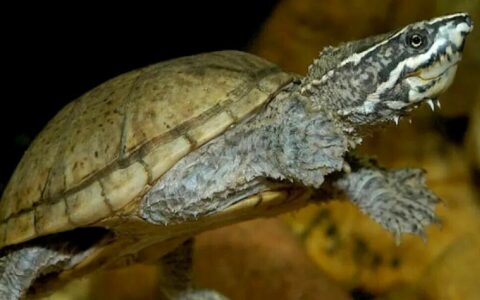
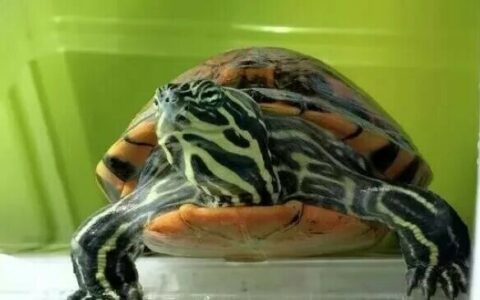
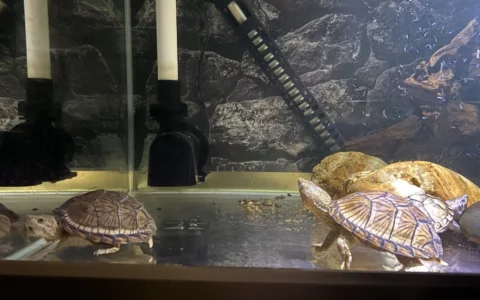
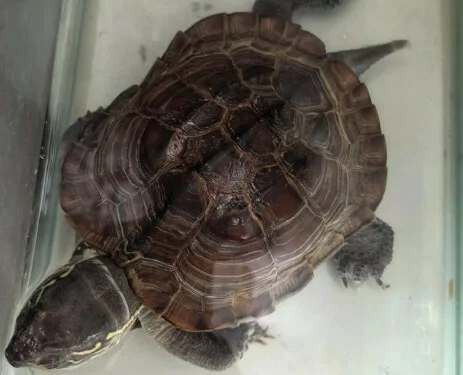
The main types of loss for turtles during hibernation in water are:
- Sickness or sudden death due to temperature differences, typically seen in hibernation in shallow water with small water bodies;
- Sickness or sudden death due to lack of security in the hibernation environment, caused by stress;
- Drowning.
The Truth About Turtles Drowning During Hibernation
Turtles can indeed drown during hibernation. A fan asked me, “Isn’t it said in a previous video that turtles don’t use their lungs to breathe during hibernation and can’t drown?”The content creator did indeed say that. During hibernation, turtles close their lungs and switch to cloacal respiration, which means they absorb dissolved oxygen through the capillaries in their bladders, so they can’t drown during hibernation. In a recent article about turtles choosing their own hibernation environment, the content creator said that turtles won’t drown in water depths of twenty to thirty centimeters, while in earlier articles, it was mentioned that deep water hibernation could easily lead to drowning. So, what’s the real story? Can turtles drown during hibernation? Is there a definitive answer?

In fact, these seemingly contradictory conclusions are both correct, with the difference being the context. For the issue of turtles drowning during hibernation, the content creator provides the following tips for reference.
Differences Between Deep and Light Hibernation
- During deep hibernation, turtles are almost completely still, and they do not rely on lung breathing, so they can’t drown.
- In a light hibernation state, turtles alternate between sleep and wakefulness, sleeping when it’s cold and becoming active when it’s warmer. During active periods, they need to use their lungs to breathe, which poses a risk of drowning. Therefore, turtles can both drown and not drown during hibernation, ultimately depending on the temperature and state of hibernation.
Conditions for Deep Water Hibernation
- During deep hibernation, turtles retract their heads, tails, and limbs into their shells and stay at the bottom of the water, so they can’t drown.
- In light hibernation, turtles still need to breathe using their lungs. If the water level is too deep, they cannot reach the surface to breathe. Why does the content creator use the word “crawl”? Because as ectothermic animals, at temperatures of several degrees Celsius, turtles cannot swim well; their swimming ability is poor, and they basically move slowly by crawling. If the water is too deep, they can’t crawl up and will drown.
The Impact of Turtle Habitats
- Natural Water Body Environment: Turtles can hibernate in deep water if the turtle habitat is like a natural water body, with a gentle slope from the deep to the shallow water area. In this way, turtles can slowly crawl from the deep water area to the shallow water area, so they won’t drown, and hibernating in deep water is also safe.
- Home Turtle Habitat: The content creator says that deep water hibernation can lead to drowning, referring to the steep-walled environment in home turtle habitats. The bottom of such containers does not have a gentle slope. Many people put a few bricks in the tank, grow some aquatic plants, and place a submerged suction cup basking platform, calling it a shallow water area. In fact, this is just an underwater support and not a shallow water area. In a steep-walled turtle habitat, deep water hibernation can indeed lead to drowning.
Changes in Hibernation Temperature
The actual hibernation temperature of turtles is constantly changing. In reality, even in the coldest month of January, turtles can hardly stay in a deep hibernation state all the time, because the temperature itself alternates between cold and warm. Once the temperature rises, causing the turtle to leave the deep hibernation state, if the water is deep, the chance of drowning will indeed increase. Without a good gradual transition environment from deep to shallow, the content creator does not recommend using deep water for turtle hibernation.
Choosing the Hibernation Environment
Generally, in the south, turtles can hibernate using shallow water and providing hiding places; in colder areas, materials like wet clothes, vermiculite, hydrogel, and sand can be used for turtle hibernation. In fact, the peak period for turtle drowning mainly occurs when the water temperature is in the teens before hibernation. At this time, the turtles have not yet hibernated, but if the breeding container has steep walls and the water level is deep, the chance of drowning is also high.
Summary and Recommendations
In summary, regarding the issue of turtles drowning during hibernation, the basic situation is as follows: they can’t drown during deep hibernation, but the conditions for deep hibernation are actually difficult to maintain stably. Therefore, whether it is hibernation or raising turtles in the autumn and winter temperatures in the teens, it is important to avoid steep-walled turtle habitats. In such environments, deep water turtle raising can easily lead to drowning, especially for small turtle hatchlings, although there is also some risk for larger turtles.
Of course, this does not mean that shallow water is safe. Shallow water has a large temperature difference, and although the chance of drowning is reduced, the chance of getting sick or dying suddenly is increased. The key is still the environment in the tank. Do you understand whether turtles can drown during hibernation and whether deep water hibernation can lead to drowning? If you still don’t understand, please leave a message. The content creator’s strength is to explain until you completely understand.
Original article by KPTer, if reproduced, please cite the source: https://www.kaipet.com/en/turtle-hibernation-guide-prevent-drowning