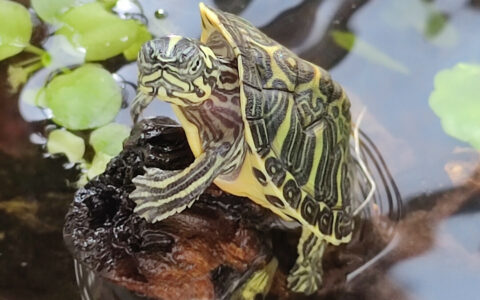
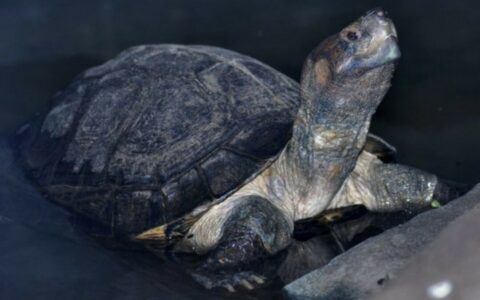
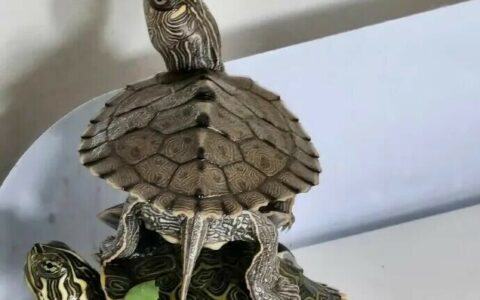
Hello everyone, the temperature has recently dropped in our area, with the lowest temperature already falling to zero degrees. My turtle, which has been clearing its intestines for over a month, can finally officially hibernate. While recording the hibernation process, I will also share with you how to operate the water-absorbent resin hibernation method.
Preparation and Use of Water-Absorbent Resin
This bag of white, small granules is the water-absorbent resin. Cut a small opening and slowly pour it into the water, continuously stirring with your hand, and then add it bit by bit. The water-absorbent resin has particularly strong water absorption, so do not be greedy and add too much at once. You can pause for a while after adding for a bit.

Allow the granules of the water-absorbent resin to expand. When stirring until a distinct jelly-like texture is achieved, dig a hole in the resin with your hand to observe. If there is no significant water accumulation in the hole, it is almost ready to use. Of course, it does not matter if it is a bit thin or thick, as long as it is not too extreme, and then you can place the turtle.
Precautions for Water-Absorbent Resin Hibernation Method
Let’s discuss some specific precautions for the water-absorbent resin hibernation method.
Clearing the Intestines
Firstly, it is essential to clear the intestines before hibernation; otherwise, the resin will be extensively contaminated, and you will have to start over. The greatest advantage of the water-absorbent resin hibernation method is its convenience. Once placed, it hardly needs any attention for the entire hibernation period. However, if the clearing of the intestines is not done properly, and the resin is extensively contaminated, it will have to be replaced, turning the advantage into a disadvantage. The general hibernation clearing of the intestines takes about half a month, but I recommend extending it to at least a month when using the water-absorbent resin method for hibernation.
Resin Depth
Secondly, how deep should the resin be? My personal experience is that it should be at least three times the thickness of the turtle. If you feel that your turtle is too large, and three times would make the resin too deep, you can use double the thickness, but not less.
Mesh Size Selection
The third point is how many mesh sizes should be chosen for the water-absorbent resin granules? “Mesh” refers to the specification of water-absorbent resin granules, with a larger mesh size indicating smaller granules. For turtle hibernation, it is generally better to choose a smaller mesh size, which means larger granules. I use a mesh size between thirty to sixty, which you can refer to.

Turtle Not Burrowing into the Resin Issue
Next is the fourth point, which is also the most frequently asked question by friends, that is, their turtles do not burrow into the resin when placed in it. This problem is actually quite simple; it is just not cold enough yet. Do not rush with hibernation; allow them to rest and clear their intestines in water before they sleep. Wait until the highest temperature drops below ten degrees before officially starting hibernation. For hibernation environments such as muddy water, coconut soil, or water-absorbent resin, below twenty degrees is just the temperature at which turtles stop eating; the hibernation temperature is much lower.
Special Situations Handling
Some friends might say that the minimum temperature in their area does not drop below ten degrees, or the time it drops below ten degrees is very short, what should they do? Actually, this is also easy to handle; Just honestly‘shallow water hibernation’is fine. Do not complicate things. Of course, there are also individuals who will not burrow no matter how cold it gets, such as my map turtle; last New Year’s Day, when the temperature dropped several degrees below zero, my map turtle only reluctantly nudged its way in, but this does not really matter.
Hibernation, under the premise of turtle health, as long as it meets the conditions of being relatively clean, moisturized, and the temperature does not drop below zero for a long time, that is enough. Whether the turtle is inside or outside the resin does not really matter. Including this year, I have been using water-absorbent resin for three years, and there has not been any turtle loss so far. I hope this experience is helpful to everyone, and I wish all of your turtles a smooth hibernation.
Original article by KPTer, if reproduced, please cite the source: https://www.kaipet.com/en/turtle-hibernation-preparation-correct-water-absorbent-resin