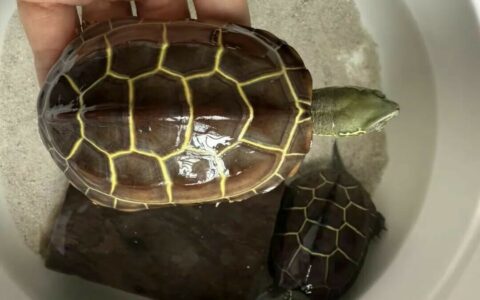
Some turtle enthusiasts who live in northern heating areas all year round are theoretically unable to experience the joy of their turtles hibernating because the temperature is not suitable. The specific reasons can be found in the collection regarding the principles of turtle hibernation.
Challenges of Personal Hibernation Conditions
Unfortunately, I am in the same situation. Once the heating comes on at home, the temperature exceeds twenty degrees, and there is no condition for hibernation. It is said online that a refrigerator can be used to make turtles hibernate, but I have not tried it myself. First, the refrigerator at home is full of food, and it does not feel very hygienic to put a few turtles in it. Secondly, I think it is not cost-effective to buy a separate refrigerator specifically for hibernation. Next, I would like to share the method by which I successfully made my turtle hibernate last year at home with heating.

Creating a Suitable Hibernation Environment
First, I chose a small, shady storage room on the north side of the house as the hibernation site, placed the turtle in the prepared hibernation environment, and settled it in the corner of the storage room, adding a lid on top to create a harmonious and safe space. This was also done to avoid a large temperature difference when the temperature drops. Then, I turned off the heating in the storage room completely. In this way, the temperature gradually dropped from over twenty degrees to about fifteen degrees.
Adjusting the Temperature for Hibernation
However, this temperature is still a bit high for the turtle’s hibernation, and the turtle does not sleep very comfortably inside. So, I opened the window, and the temperature in the storage room dropped to about ten degrees the next day, which is quite suitable for the turtle to hibernate.
Observation and Maintenance of Hibernation Status
A few days later when I checked again, the turtle had already burrowed into the hibernation environment I had prepared in advance and was sleeping. As long as the temperature in the storage room can be kept around ten degrees, hibernation is essentially half successful.
I used a water-retaining agent for hibernation, so there was no issue with drying and hydration. In the early stage, I would come to check every half a month to observe if there were any abnormalities with the turtle. If everything was normal, the interval between checks could be extended to one to two months.
Revival After Hibernation
When the flowers bloom in the spring next year, the turtle will emerge on its own. If you don’t have a storage room, you can also try using a compartment in the underground garage stairs or an unused small bedroom. In short, as long as you find a place suitable for hibernation with a temperature of about ten degrees, it will do.
Original article by KPTer, if reproduced, please cite the source: https://www.kaipet.com/en/turtle-hibernate-heating-indoor-turtle-hibernation-techniques-northern-regions