

- First, move the sick turtle to a separate new container (like a plastic box or a shallow tank) to avoid cross-infection with healthy turtles and prevent the spread of pathogens. Since skin rot thrives in moisture, keep the environment dry except for daily scheduled soaking in water (for drinking and defecation).
- Use a disinfectant like povidone-iodine / hydrogen peroxide to wipe the affected area, removing the surface rotten tissue and mucus (if there is loose skin, you can gently peel it off to expose fresh tissue, but do not forcibly tear it).
- Using a cotton swab, apply Povidone-iodine solution (Note: a skin disinfectant) (a 10% concentration needs to be diluted 10-fold to avoid irritation) evenly to the affected area once a day. Alternatively, use Mupirocin ointment (Note: an antibacterial ointment), applying a thin layer. After applying the medication, wait 5-10 minutes for it to be absorbed before returning the turtle to its dry-docking environment.
- Check the affected area daily. If the white parts subside and the skin returns to its normal color within 3-5 days, you can gradually return to normal care (transition first with “semi-dry-docking”: dry-docking during the day and keeping in shallow water at night, then slowly restore the normal water level).
White Eye Disease
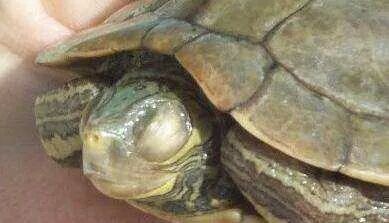
The “white eye” here doesn’t mean rolling one’s eyes, but rather White Eye Disease. It is also a disease caused by water pollution (bacterial / fungal growth), large environmental temperature fluctuations, vitamin A deficiency, or eye trauma (such as friction or foreign object irritation). If not treated in time, it can lead to the turtle’s eyes being completely sealed shut, blindness, and even death from organ failure due to refusing to eat.
Symptoms
Symptoms of white eye disease: Mild swelling of the turtle’s eyelids, with the skin around the eyes turning white and raised. In severe cases, a pale yellow viscous discharge will be produced. The eyelids will ulcerate, and if not cleaned in time, the infection can lead to eyeball necrosis.
Treatment Method
Treatment Method:
- Again, move the sick turtle to a separate new container (like a plastic box or a shallow tank) to avoid cross-infection with healthy turtles and prevent pathogen spread, while also keeping the environment dry.
- As the eyeballs are fragile, you can use a less irritating saline solution with a clean cotton swab to gently wipe around the turtle’s eyes, softening and removing the viscous discharge.
- Use Levofloxacin eye drops (Note: antibiotic eye drops), applying 1-2 drops into the gap of the eyelids, 3 times a day. If the condition is severe, it can be paired with Erythromycin eye ointment (Note: antibiotic eye ointment), once a day. Use a cotton swab to apply a small amount gently to the swollen area around the eye (avoid getting the ointment into the eye to prevent irritation).
- Check if the eyes are opening daily. If the eyelid swelling subsides and the turtle can open its eyes normally within 3-5 days, you can reduce the frequency of medication (change to once a day). After another 2 days of consolidation, gradually transition to “semi-dry-docking” (dry-docking during the day, shallow water at night).
Gastroenteritis
The cause of gastroenteritis is mainly related to improper diet, such as feeding hard adult turtle food to hatchlings, which they cannot digest, or feeding too much at once. In some cases, it can also be triggered by poor environmental control or pathogen infection.
Symptoms
Symptoms of gastroenteritis: The onset of gastroenteritis in turtles is mainly reflected in their feces. Normal feces should be brown and solid in a strip shape. The feces of a turtle with gastroenteritis are loose, soft, and unformed, with a lighter color. Some may be mucous-like, watery, with white flocculent material, etc. In severe cases, the feces may contain blood streaks, be dark red, or appear black and tar-like, with a noticeable foul smell.
Treatment Method
Treatment Method:
- Similarly, isolate the turtle, but it can be kept in water. Use a heating rod to stabilize the water temperature at 28-30°C. At this temperature, the turtle’s immune and digestive functions are strongest. Avoid water temperature fluctuations; a thermostat can be used, with an error margin not exceeding 2°C.
- First, stop feeding for 3-5 days to allow the intestines to empty and rest. Regulate the gut with probiotics: use a turtle-specific “Chang Wei Bao” (Note: a turtle probiotic product) (follow the dosage on the instructions, 1/4 of a sachet per 500g turtle), or human-use “Bacillus subtilis and Enterococcus faecium (Live) Granules” (Note: a probiotic preparation) (also with a reduced dosage). Dissolve it in water for the turtle to drink, once a day for 3-5 consecutive days.
As turtles have become popular pets in recent years, it’s inevitable that newcomers to the turtle-keeping community, due to their inexperience, may cause their beloved turtles to fall ill. This can be due to factors like improper management of the living environment, dietary imbalances, or the turtle’s own stress response, leaving owners feeling helpless.
In this post, I, the author, have compiled a treatment guide for several common turtle diseases to help you easily master the methods and provide treatment at home, allowing your little turtle to grow up healthy.
Skin Rot
Skin rot is one of the most common diseases in pet turtles, especially during their hatchling stage and when they first arrive home. Turtles often develop skin rot symptoms due to surrounding disturbances and changes in water quality, such as water changes or turbidity caused by leftover food debris.
Symptoms
Symptoms of skin rot: Localized whitening and swelling of the skin. If not treated promptly, it will begin to ulcerate, forming “patches of skin rot.” The ulcerated areas may ooze transparent mucus. In later stages, the ulceration can deepen into the lower layers of the skin, exposing raw red flesh, accompanied by a foul odor. In severe cases, large areas of skin on the limbs and neck may slough off, and the turtle will become lethargic and refuse to eat.

Treatment Method
Treatment Method:
- First, move the sick turtle to a separate new container (like a plastic box or a shallow tank) to avoid cross-infection with healthy turtles and prevent the spread of pathogens. Since skin rot thrives in moisture, keep the environment dry except for daily scheduled soaking in water (for drinking and defecation).
- Use a disinfectant like povidone-iodine / hydrogen peroxide to wipe the affected area, removing the surface rotten tissue and mucus (if there is loose skin, you can gently peel it off to expose fresh tissue, but do not forcibly tear it).
- Using a cotton swab, apply Povidone-iodine solution (Note: a skin disinfectant) (a 10% concentration needs to be diluted 10-fold to avoid irritation) evenly to the affected area once a day. Alternatively, use Mupirocin ointment (Note: an antibacterial ointment), applying a thin layer. After applying the medication, wait 5-10 minutes for it to be absorbed before returning the turtle to its dry-docking environment.
- Check the affected area daily. If the white parts subside and the skin returns to its normal color within 3-5 days, you can gradually return to normal care (transition first with “semi-dry-docking”: dry-docking during the day and keeping in shallow water at night, then slowly restore the normal water level).
White Eye Disease
The “white eye” here doesn’t mean rolling one’s eyes, but rather White Eye Disease. It is also a disease caused by water pollution (bacterial / fungal growth), large environmental temperature fluctuations, vitamin A deficiency, or eye trauma (such as friction or foreign object irritation). If not treated in time, it can lead to the turtle’s eyes being completely sealed shut, blindness, and even death from organ failure due to refusing to eat.
Symptoms
Symptoms of white eye disease: Mild swelling of the turtle’s eyelids, with the skin around the eyes turning white and raised. In severe cases, a pale yellow viscous discharge will be produced. The eyelids will ulcerate, and if not cleaned in time, the infection can lead to eyeball necrosis.
Treatment Method
Treatment Method:
- Again, move the sick turtle to a separate new container (like a plastic box or a shallow tank) to avoid cross-infection with healthy turtles and prevent pathogen spread, while also keeping the environment dry.
- As the eyeballs are fragile, you can use a less irritating saline solution with a clean cotton swab to gently wipe around the turtle’s eyes, softening and removing the viscous discharge.
- Use Levofloxacin eye drops (Note: antibiotic eye drops), applying 1-2 drops into the gap of the eyelids, 3 times a day. If the condition is severe, it can be paired with Erythromycin eye ointment (Note: antibiotic eye ointment), once a day. Use a cotton swab to apply a small amount gently to the swollen area around the eye (avoid getting the ointment into the eye to prevent irritation).
- Check if the eyes are opening daily. If the eyelid swelling subsides and the turtle can open its eyes normally within 3-5 days, you can reduce the frequency of medication (change to once a day). After another 2 days of consolidation, gradually transition to “semi-dry-docking” (dry-docking during the day, shallow water at night).
Gastroenteritis
The cause of gastroenteritis is mainly related to improper diet, such as feeding hard adult turtle food to hatchlings, which they cannot digest, or feeding too much at once. In some cases, it can also be triggered by poor environmental control or pathogen infection.
Symptoms
Symptoms of gastroenteritis: The onset of gastroenteritis in turtles is mainly reflected in their feces. Normal feces should be brown and solid in a strip shape. The feces of a turtle with gastroenteritis are loose, soft, and unformed, with a lighter color. Some may be mucous-like, watery, with white flocculent material, etc. In severe cases, the feces may contain blood streaks, be dark red, or appear black and tar-like, with a noticeable foul smell.
Treatment Method
Treatment Method:
- Similarly, isolate the turtle, but it can be kept in water. Use a heating rod to stabilize the water temperature at 28-30°C. At this temperature, the turtle’s immune and digestive functions are strongest. Avoid water temperature fluctuations; a thermostat can be used, with an error margin not exceeding 2°C.
- First, stop feeding for 3-5 days to allow the intestines to empty and rest. Regulate the gut with probiotics: use a turtle-specific “Chang Wei Bao” (Note: a turtle probiotic product) (follow the dosage on the instructions, 1/4 of a sachet per 500g turtle), or human-use “Bacillus subtilis and Enterococcus faecium (Live) Granules” (Note: a probiotic preparation) (also with a reduced dosage). Dissolve it in water for the turtle to drink, once a day for 3-5 consecutive days.
Original article by 搬运工, if reproduced, please cite the source: https://www.kaipet.com/en/read-beginners-complete-guide-symptoms-treatment-turtle-skin-rot-white-eye-disease-gastroenteritis



Comments(2)
This is so helpful! As a new turtle owner, I’m curious: what’s one common mistake to avoid during treatment?
@CriticX:您好!很高兴指南能帮到您。新手治疗时,一个常见错误是未严格遵循药物稀释比例,如碘伏需稀释10倍以避免刺激。此外,涂抹药膏后务必等待吸收,并确保环境(如干养)稳定。祝您的爱龟早日康复!