

A soul-searching question: What causes your little turtle to suffer from “white eye disease”? There are the following 3 possibilities. First, compare and see which category your turtle falls into.
Why Do They Get “White Eye Disease”
Poor Water Quality Environment
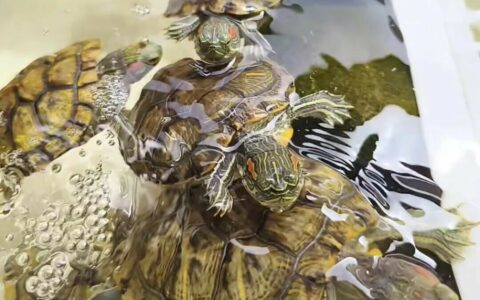
The aquatic environment is crucial. If the water quality is unclean, Aeromonas bacteria (Note: may refer to “Aeromonas hydrophila”) will multiply in large numbers, which can easily trigger “white eye disease” in turtles. This is just like how we are more likely to get sick when living in a dirty and messy environment.
For novice turtle keepers, it’s recommended to throw away “colored stones”and “plastic flowers”—the farther, the better. A “bare-bottom tank” is best.
Vitamin A Deficiency
Vitamin A plays a key role in the eye health of turtles. When a turtle lacks this important nutrient, it can create a hidden risk for “white eye disease.”
Long-term Refusal to Eat and Poor Constitution
Turtles that do not eat for a long time are in poor physical condition with a weakened immune system, making them more susceptible to “white eye disease.” Additionally, “white eye disease” often occurs alongside traditional turtle illnesses such as pneumonia, gastroenteritis, and abnormal liver function.
White eye disease is also highly contagious, so be sure to isolate other turtles promptly.
Stages of White Eye Disease Development
Initial stage: The eyes become inflamed and swollen. The turtle will constantly scratch its eyes with its front claws, and eye discharge increases.
Middle stage: The cornea becomes swollen and ulcerated, and the eyeball is gradually covered by a white discharge.
Severe stage: The condition worsens, leading to blindness in the turtle.
Therefore, it is very important to take action as soon as you notice any abnormalities.
How to Treat “White Eye Disease”
Dry-docking Treatment
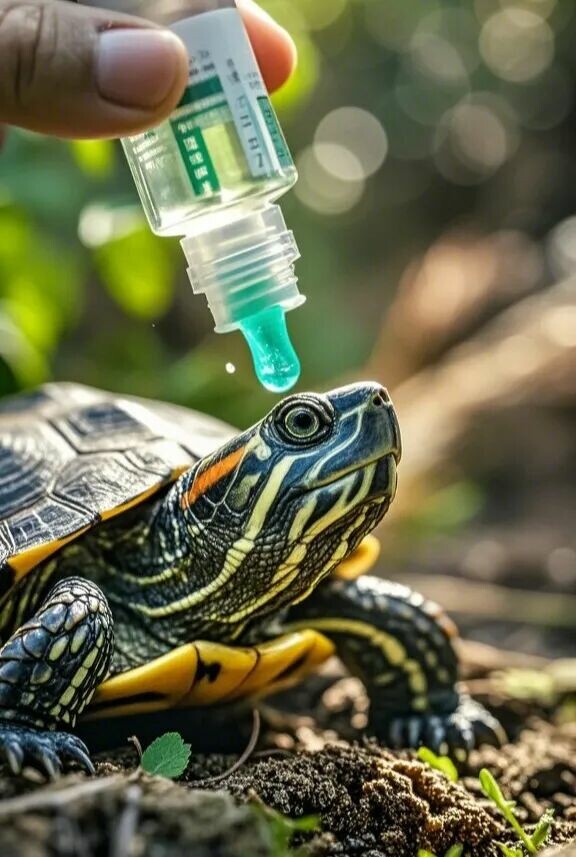
Initial stage: When the turtle can still open its eyes, you can use eye drops for treatment, which is simple and convenient.
Here, I recommend the eye drops I commonly use: Levofloxacin Hydrochloride, Chloramphenicol, or Tobramycin. Choose one of these three for the eye drop treatment. Note that Chloramphenicol eye drops and Erythromycin eye ointment cannot be used together, as they have an antagonistic effect that will not only fail to treat the condition but may also harm the turtle.

Apply the drops 2 – 3 times a day, and “dry-dock” the turtle for about 30 minutes after each application. During dry-docking, pay attention to the temperature and try to minimize temperature fluctuations to prevent the turtle’s condition from worsening due to temperature-related discomfort.
Severe stage: If the turtle’s eyelids are white and swollen and it cannot open its eyes, you must first carefully clean out the white discharge to create a suitable condition for subsequent treatment.
After cleaning, apply Erythromycin eye ointment to the swollen area. If you do not have Erythromycin eye ointment, or if the turtle has difficulty opening its eyes, you can drip Levofloxacin Hydrochloride, Chloramphenicol, or Tobramycin eye drops along the slit of the eye.
Force-feeding Treatment
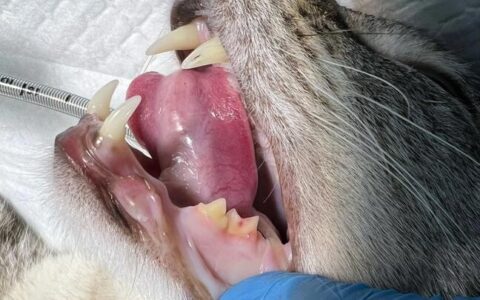
Some turtles get “white eye” due to a lack of vitamin A in their bodies. In this case, turtle keepers can use a syringe connected to a soft tube to force-feed the turtle a pet nutritional supplement.
These supplements are rich in vitamin A. For turtles under 5 cm, force-feed 0.5 ml at a time; for turtles over 5 cm, force-feed 1 ml at a time, twice a day, to help the turtle replenish its nutrients and fight “white eye disease.”
Medicated Bath Treatment
This treatment method is usually a backup plan and is less commonly used in the treatment of “white eye disease.”
Conclusion
I hope this article can help fellow turtle enthusiasts to no longer be flustered when facing their turtle’s “white eye disease.”
Common turtle problems, such as pneumonia and skin rot, require careful attention from their owners. I will write dedicated articles to share more on these topics in the future.
Original article by 搬运工, if reproduced, please cite the source: https://www.kaipet.com/en/turtle-white-eye-disease-analysis-3-major-scientific-treatment-methods





Comments(2)
Thanks for the detailed guide! What’s the best daily care routine for water quality to effectively prevent white eye disease?
@CriticX:You’re very welcome! Maintaining excellent water quality is indeed key. As mentioned in the article, a clean aquatic environment is crucial to prevent bacterial growth. A ‘bare-bottom tank’ is often recommended for easier maintenance and hygiene to effectively prevent white eye disease.