

Many people don’t even know that turtles have different sexes, let alone how to tell them apart—they simply don’t know where to start. You might not know or be sure whether the turtle you’re raising is male or female. You probably didn’t pay attention when you bought it. In fact, distinguishing between male and female turtles is quite easy. Below, we’ll share 5 common methods to do so.
Distinguishing by Physical Appearance
Look at the Claw Length
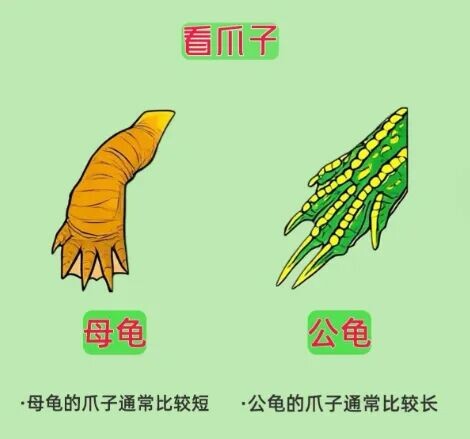
The claw lengths of male and female turtles are different. If you notice your turtle has relatively long claws, it’s a male. Conversely, shorter claws indicate it’s a female.
Look at the Tail’s Length and Thickness
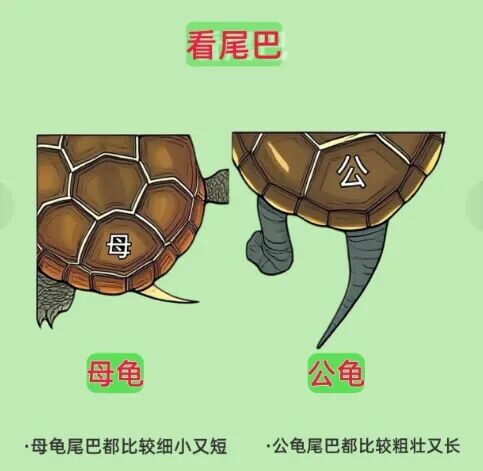
A male turtle’s tail is relatively thick and long, while a female turtle’s tail is shorter and thinner. You can quickly determine a turtle’s sex by its tail’s length and thickness.
Observe the Difference in Body Size
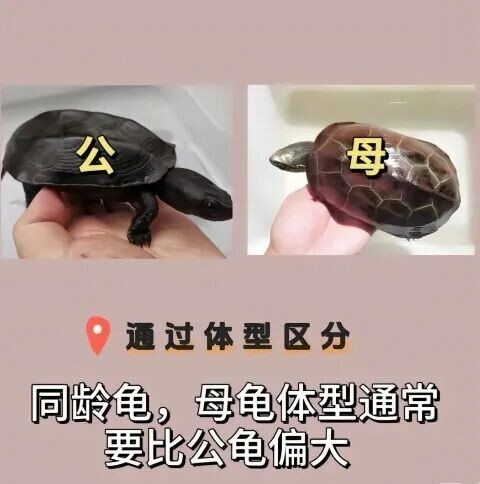
Among turtles of the same age, females are typically larger than males. However, this method cannot be used to distinguish between turtles of different ages.
Distinguishing by Specific Body Parts
Look at the Vent’s Position
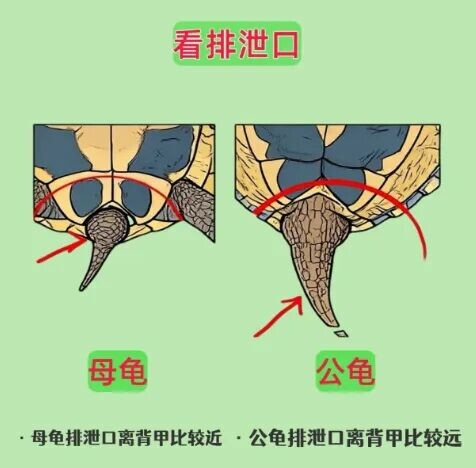
A female turtle’s vent is located relatively far from the carapace, while a male turtle’s vent is also located far from the carapace. The difference between the two is significant. Those who are familiar with this can probably tell at a glance.
Observe the Shape of the Abdomen
The abdomens of male and female turtles are different. Comparatively, a female’s abdomen is relatively flat, while a male’s abdomen is usually concave. This method is not effective for juvenile turtles; it works better for turtles with a carapace of 10 cm (approx. 3.9 inches) or longer.
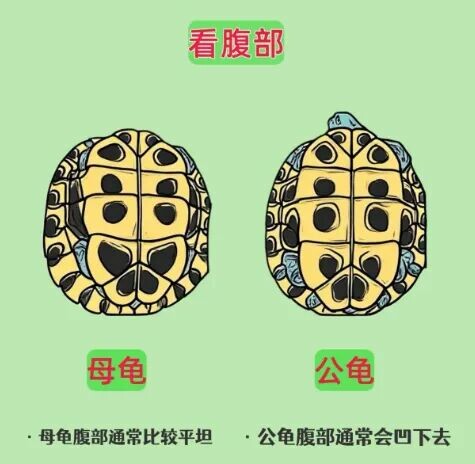
Other Auxiliary Identification Methods
In addition to the common methods above, you can also tell the difference by the iris of the eye. For most male turtles, there is a red or gold ring around it, while a female’s is usually pure black or light brown. This identification method is quite subtle. Another method is to distinguish by body odor; male turtles have a scent, while female turtles are almost odorless. This method is also rather niche and may not be very accurate.
If you want to quickly determine a turtle’s sex, you can use methods like checking the tail length, claw length, vent position, and abdomen. These are the common ways to tell them apart. Additionally, you can distinguish them by body size, eye iris, and body odor. The conventional methods make it quite easy to differentiate, sometimes even at a glance. So, is your turtle male or female? Go and check now!
Original article by 搬运工, if reproduced, please cite the source: https://www.kaipet.com/en/turtles-sex-5-key-features-check-claws-tail-abdomen








Comments(2)
Great tips! For claw and tail length, is there a specific age or size when those differences become clear?
@CriticX:Thank you for your kind words! For claw and tail length, these differences generally become more apparent as turtles mature. For precise age/size, it can vary by species. We recommend observing over time or consulting a vet for specific guidance.