


“How deep should the water for my turtle be?” This is a question that has likely troubled every turtle keeper (friends who raise turtles). If the water is too shallow, you see your turtle unable to move in a “small puddle,” worrying about health problems from lack of exercise.
If the water is too deep, you are constantly worried that your turtle might struggle to paddle but be unable to surface for air, ultimately drowning.
This seemingly simple choice concerns your beloved turtle’s vitality, physique, and even its life. In fact, the key to solving this dilemma is not an either-or choice between “deep” and “shallow,” but rather a clever “fusion” and “transition.”
Deep and Shallow Water: The Turtle’s “Gym” and “Rest Stop”
Although turtles are amphibious animals, the swimming abilities of different species and individuals vary greatly. Therefore, we cannot generalize, but should instead understand the significance of different water depths for turtles.
Shallow Water Area: A Guarantee of Life and Safety
Core function: Easy breathing and a sense of security. The core design standard for a shallow water area is to allow the turtle’s head to easily emerge from the water to breathe when all four feet are on the ground. This is crucial for juvenile turtles, sick turtles, turtles that have just arrived and are not yet adapted to the environment, and species that are not naturally expert swimmers (such as most semi-aquatic turtles (turtle species that can live both in water and on land)).
This is the turtle’s “safe haven,” allowing it to get oxygen effortlessly when tired, frightened, or in need of rest, greatly reducing the risk of drowning.
Added value: Basking and feeding. The shallow area is usually connected to a basking platform, making it convenient for the turtle to get on and off. Also, feeding in shallow water can reduce the turtle’s stress, allowing it to eat more calmly.
Deep Water Area: The Natural Gym
Core function: Promoting exercise and shaping a good physique. Deep water provides ample space for turtles to swim. To breathe, a turtle needs to constantly swim from the bottom to the surface, a process that greatly exercises its limb muscles and cardiopulmonary function.
Sufficient exercise can effectively prevent problems like obesity and weak limbs in turtles, and allows the carapace to develop more symmetrically and healthily.
Simulating nature and enriching behavior: In the wild, turtles need deep water to hunt, explore, and hide from natural predators. A sufficiently deep area can stimulate a turtle’s natural instincts, reduce stereotypical behavior (repetitive, meaningless actions displayed by animals in unnatural or confined environments for extended periods), and make its life more rich and varied.
The Golden Rule: Scientifically Setting Up Deep and Shallow Water Areas
“Setting up both deep and shallow water areas” is the most effective strategy to resolve this conflict. Of course, the prerequisite is that the environment must be large enough.
Deep Water Area Standard: The Carapace Length Multiplier Method
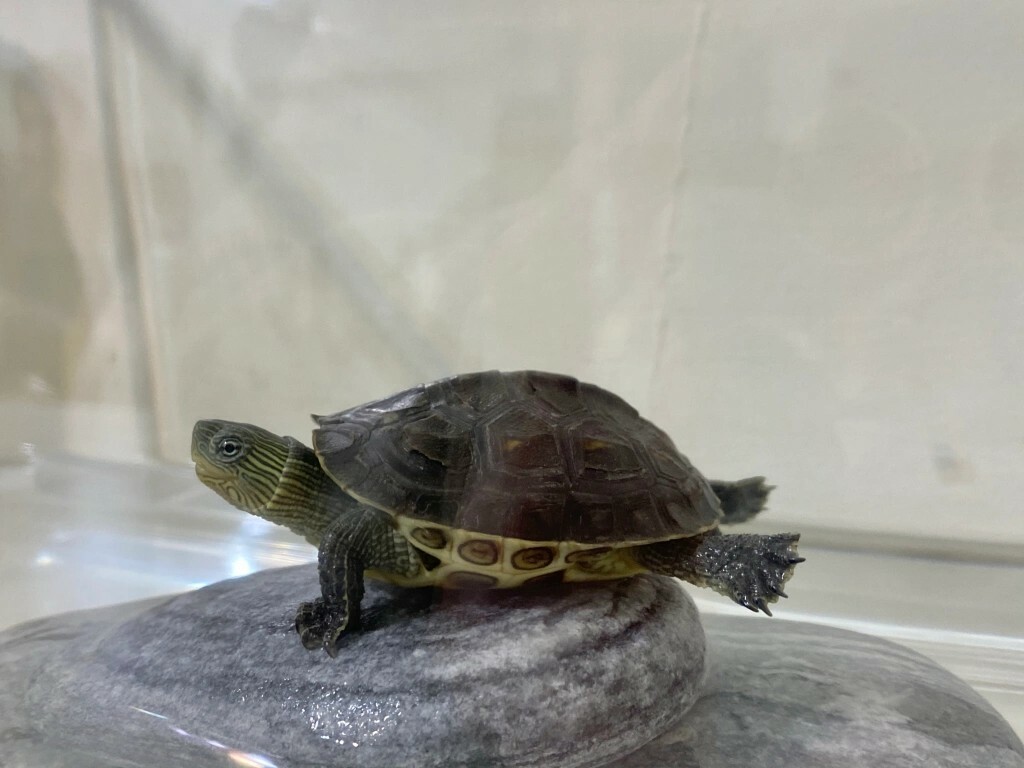
“A water depth of about 2 to 3 times the carapace length” is a very practical and scientific reference standard. We can refine this: Juvenile turtles / Turtles with average swimming ability: Control the water depth at 1.5 – 2 times the carapace length. For example, for a Reeves’ turtle with a 5 cm carapace, the initial deep water area can be set to 7.5-10 cm.
Adult / Healthy / Strong swimming turtles (e.g., Reeves’ turtle, Chinese stripe-necked turtle, some musk turtles): The water depth can be safely increased to 2 – 3 times or even more. For a 10 cm adult turtle, a water depth of 20-30 cm is well within its comfort zone.
Experienced keepers / Deep-water species (e.g., Razor-backed musk turtle, Loggerhead musk turtle, Pig-nosed turtle): These are true swimming experts. The water depth can be set to 3-4 times or deeper, accompanied by a powerful filtration system.
Shallow Area and Transition Zone Design
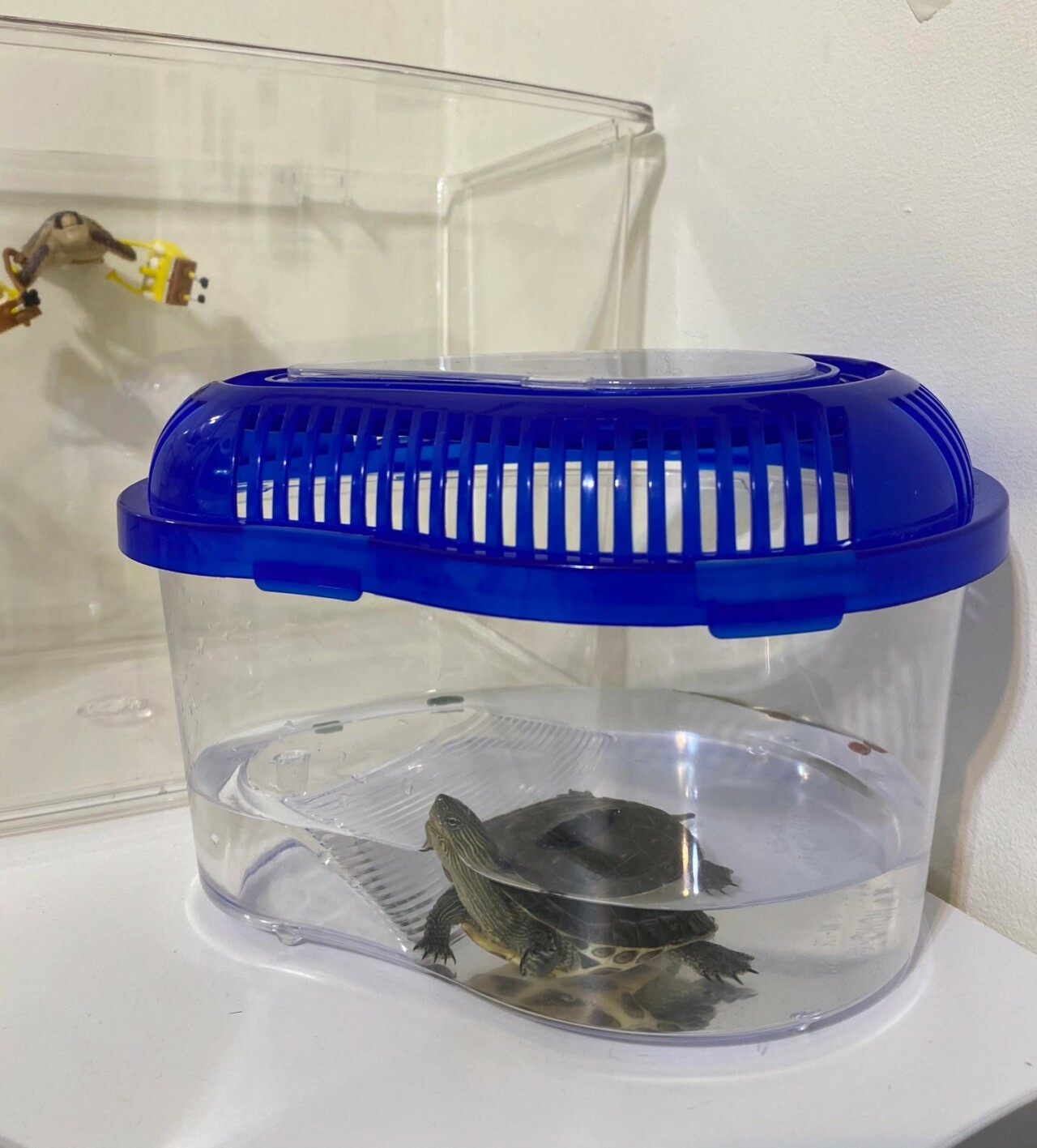
Shallow area standard: Strictly follow the “nose out of water” principle. The water level should be just over or slightly below the carapace.
A gentle slope is the “soul”: The connection between the deep and shallow areas (and the basking platform) must not be a steep cliff. A rough, high-friction slope must be provided to allow the turtle to climb effortlessly. You can use driftwood, slate, or a special turtle tank ramp. A smooth transition can completely eliminate a turtle’s anxiety and the risk of drowning.
Building the Ideal Turtle Tank Environment
A successful turtle tank is not just about the combination of water depths, but a complete ecosystem.
Basking Platform: The Indispensable “Floating Island”
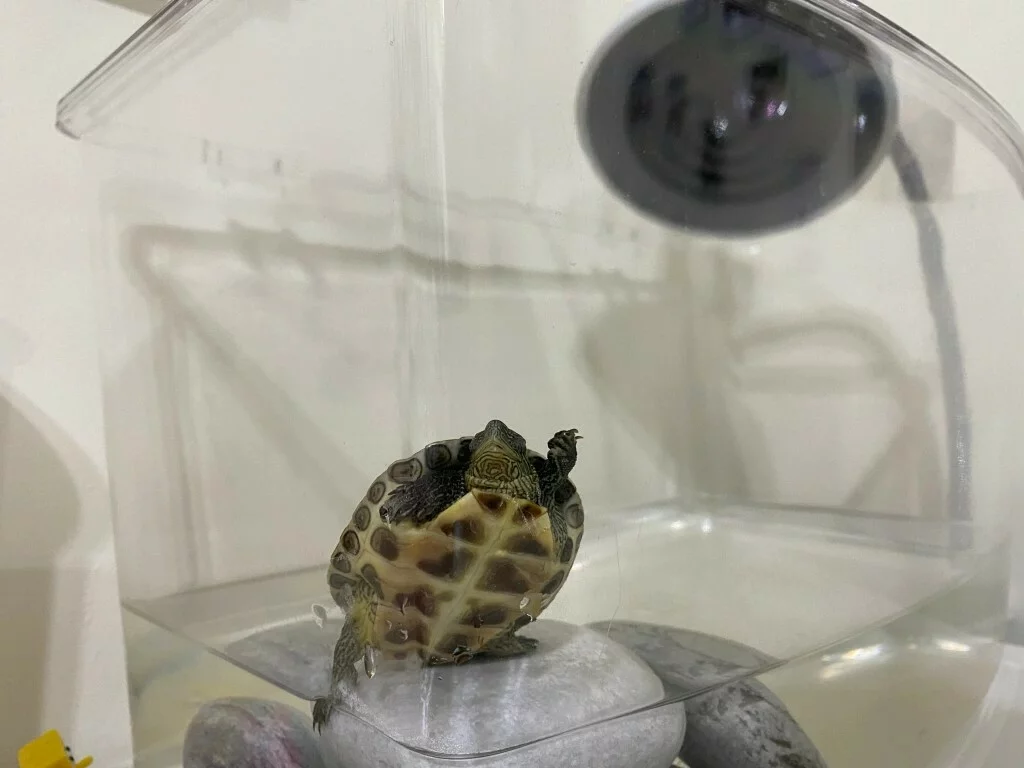
The basking platform is an extension and the highest point of the shallow area. Turtles need to leave the water to completely dry their bodies to absorb heat for digestion, prevent skin and shell rot (common skin or shell diseases in turtles, often caused by poor water quality, a damp environment, or malnutrition), and promote the synthesis of Vitamin D3 (a fat-soluble vitamin crucial for a turtle’s calcium absorption, bone development, and shell health).
Climbing and Resting Points
Even in the deep water area, some intermediate resting points should be provided, such as tall driftwood branches or clumps of aquatic plant leaves (if plastic, ensure there are no sharp points). This is equivalent to a “highway service area” in the water, allowing the turtle to stop and take a breather after a long swim.
Water Quality Management
The deeper the water, the greater the volume, and the relatively more stable the water quality.
The Art of Turtle Keeping
Keeping a turtle is about cultivating a state of mind, and it is also a science. Regarding the dilemma of water depth, the answer has never been a black-and-white “deep” or “shallow.” The wisest art of turtle keeping lies in creating an environment full of choices for our silent companions: when the turtle wants to swim freely, there is vast deep water; when the turtle wants to rest, there are accessible shallows.
Deep water for exercise, shallow water for survival, a gentle slope to connect them, and a basking platform is a must.
Original article by 搬运工, if reproduced, please cite the source: https://www.kaipet.com/en/turtle-water-depth-deep-water-exercise-shallow-water-survival-golden-layout-healthy-turtle





Comments(2)
What a clear guide! Beyond the examples, are there other common turtle species known to be true deep-water experts?
@CriticX:Thanks for your feedback! The article focuses on commonly kept deep-water experts like Razor-backed musk, Loggerhead musk, and Pig-nosed turtles. While there are others, these are widely recognized for their swimming prowess. Always research specific species!