

I wonder if you have heard of the guide dog scam. A while ago, this blogger noticed that the reposts on the “China Guide Dog” Weibo account were full of calls for a boycott. Out of curiosity, I did a quick search, and the results caused the understanding I had built up over decades to collapse on the spot.
Netizens say that behind every guide dog lies a breeding cost as high as 200,000 RMB.
In the statistics released by the China Disabled Persons’ Federation in 2019, the number of blind people in China had already reached 17 million. Meanwhile, the money-guzzling guide dog bases can only output dozens of guide dogs each year. The total number of guide dogs nationwide, counting everyone from grandfathers to grandsons (all generations), is only about 200. For context, the population of giant pandas in China is over 1,800.
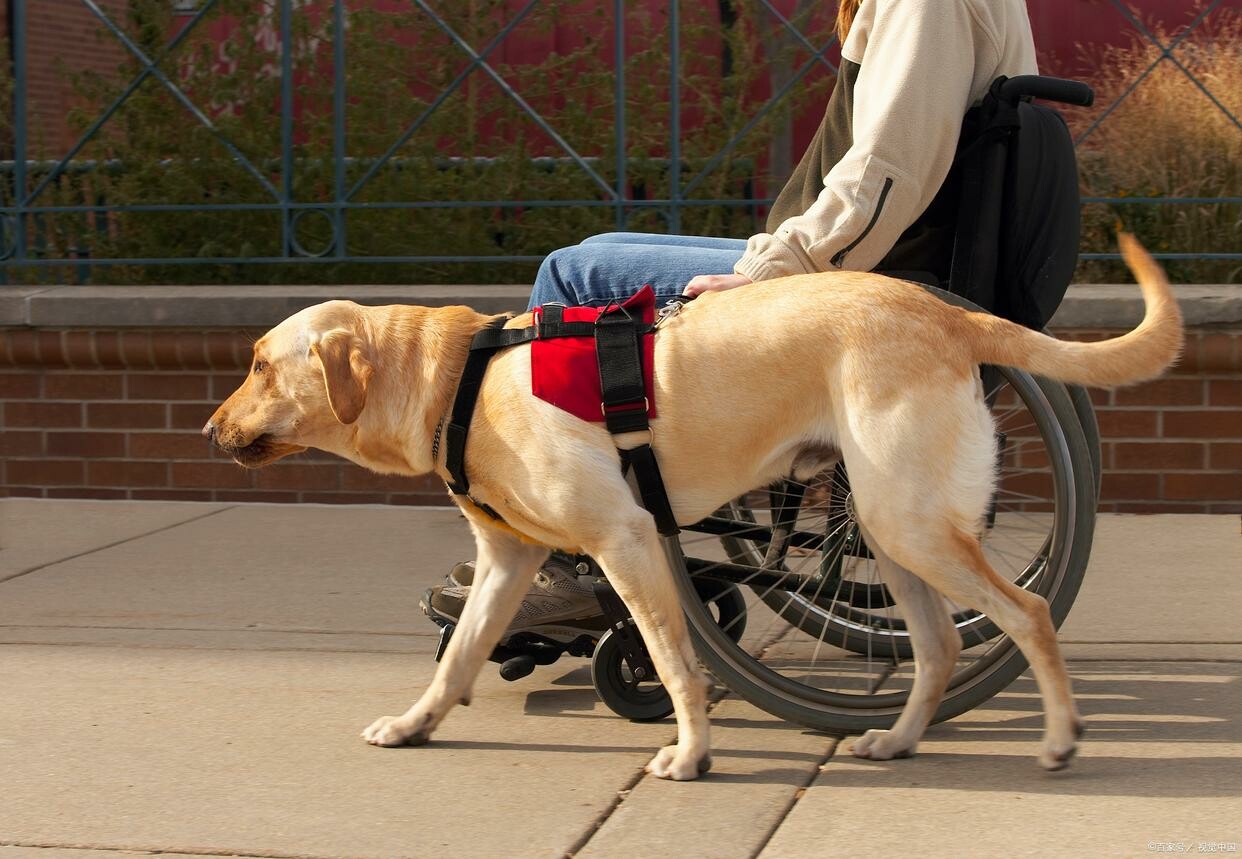
Amidst the discussions, this blogger found that the so-called “Godsend for the blind” is actually just a luxury item for the privileged: those who can afford to buy and keep guide dogs are essentially the wealthy, highly self-reliant blind elite. Moreover, despite spending so much money, the dog might not even be useful. According to reports by Xinhua News Agency, a private guide dog agency previously caused a scandal when one of their guide dogs urinated while walking. Coupled with the fact that dogs are born with red-green color blindness (poor cone cell function), isn’t using them for guiding just playing with the lives of the blind?
Therefore, netizens generally believe that guide dog agencies are using the media to constantly hype up this inefficient industry, with the ultimate goal of defrauding state subsidies by garnering sympathy and love from society. This led to the situation mentioned at the beginning, where netizens collectively reposted boycotts on the “China Guide Dog” Weibo. Many netizens also stated that current smart devices can completely replace guide dogs, arguing that smart canes and barrier-free facilities are what blind people truly need.
However, my intuition told me it wasn’t that simple. That afternoon, I made a phone call with a bellyful of questions. I contacted China’s first guide dog training base directly—the Dalian Guide Dog Training Base. The Dalian Guide Dog Training Base once drafted the national standards for Chinese guide dogs together with the China Association of the Blind and other institutions; they can be said to be the group of people who understand guide dogs best in China.
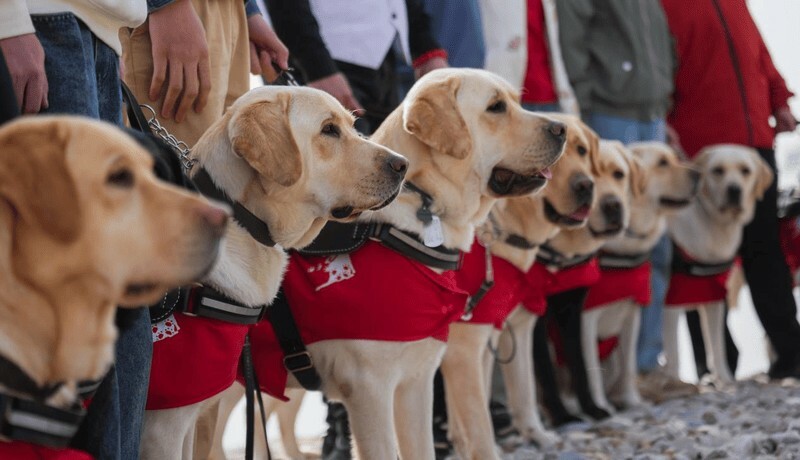
Investigation and Interviews: Facts Are Often More Complex Than Doubts
After talking on the phone with the staff at the Dalian training base for 2 hours, I discovered that the matter seems far more complicated than imagined. Afterwards, we interviewed many relevant personnel, including other private guide dog companies, blind people who have used guide dogs, people who cannot use guide dogs, and companies that have made smart canes. We discovered something even more cruel: guide dogs are indeed a luxury item, but unfortunately, no mass-produced smart guide device can currently surpass a guide dog.
After organizing this interview content totaling tens of thousands of words, I want to break down the topic of guide dogs and explain it to everyone in detail.
Are Guide Dogs Actually Useful?
Core Function is Obstacle Avoidance
First point: are guide dogs actually useful? The answer is they are useful, but they are not omnipotent. Many media outlets hype them up extravagantly, claiming guide dogs can help owners fetch things or do housework, which is all “nonsense.” The core function of a guide dog is just one thing: obstacle avoidance.
The working principle of a guide dog is actually obedience to commands: they can understand over 30 types of commands including go straight, turn left, etc. The blind person judges the route themselves and issues commands to the guide dog. The guide dog then proceeds according to the commands and helps the owner avoid obstacles on the path. Guide dogs perform active avoidance, meaning they dodge obstacles before encountering them. Having undergone tens of thousands of training sessions, they can develop conditioned reflexes to road obstacles, which is much more efficient than the passive avoidance of a cane.
As intelligent creatures, the biggest difference between them and a cane is that they can make their own judgments. Most of the time, guide dogs will obey their owner’s commands, but when the owner issues a wrong command, the guide dog needs to judge for itself. We call this intelligent disobedience (referring to the behavior where a guide dog actively refuses to obey out of protection for the owner when a dangerous command is issued).

How to Cross the Road
Because dogs lack the cone cells that perceive red, traffic lights appear as different shades of gray in their eyes. Therefore, guide dogs rely mainly on the owner’s commands and judgment of real-time traffic conditions to cross the road. The guide dog needs the blind person to make the first judgment: although blind people cannot see traffic lights, they have a perception of traffic flow and can sense whether cars are coming from the opposite direction or from the sides. When the blind person feels it might be safe, they will continuously ask the dog “Go.” Upon receiving the command, the guide dog observes the flow of cars and people. If the guide dog discovers the road conditions are unsafe, such as a vehicle entering from the right, they will perform intelligent disobedience and block the owner until the vehicle passes.
Besides avoiding obstacles, they can also remember at least 7 common routes. For example, from the subway station to home, you only need to shout “Go home,” and the dog can lead you off on its own.
Costs and Funding: Where Did the 200,000 RMB Go?
But even if guide dogs are useful, at 200,000 RMB, they are so expensive that only wealthy blind people can afford them in the end. This blogger was also puzzled at first, until I discovered that the buying and selling of guide dogs is not allowed in China; all legitimate guide dogs are only available for free adoption by blind people. Furthermore, according to the adoption standards of the Dalian Guide Dog Base, only Level 1 and 2 totally blind individuals with the most severe visual impairment are eligible to adopt a guide dog.
Not only does the guide dog business fail to bring revenue to the base, but the state also does not provide relevant funding. Currently, there are only two bases, in Shanghai and Dalian. For every qualified guide dog trained, the local government provides a subsidy of 60,000 RMB. The guide dog bases, which appear to “spend money like water,” can basically only scrape by on social donations. This made me even more curious: where exactly did this 200,000 RMB go?

To answer this doubt, I directly asked for the 2021 audit report of the Dalian Guide Dog Base. We looked for the answer directly in the data:
- In 2021, the Dalian Guide Dog Base had a total of 105 dogs in training and 40 graduate dogs. The base’s total training cost expenditure was 6.84 million RMB.
- Graduate dogs still have to undergo pairing training with blind people. In the end, only 35 guide dogs were successfully paired. When averaged out, the training cost per single guide dog reached 196,000 RMB.
- So, training a qualified guide dog truly requires this much cash.
Knowing how much was spent isn’t enough; we also need to see where this 196,000 RMB went. The so-called training costs are divided into three main parts: dog training costs, material donations, and research funding:
- Dog Training Costs (including dog and labor expenses) totaled 117,000 RMB. I looked through it and found that the two largest items were wages and dog food.
- Dog food consumption costs 400,000 RMB a year; each dog consumes 11,000 RMB per year.
- The annual expenditure for employee wages at the base is 2.35 million RMB. Calculated per head, the average annual salary for employees is only 67,000 RMB. These two costs together amount to nearly 80,000 RMB, directly accounting for close to half of the cost.
- Material Donations: All donations received by the institution throughout the year, such as dog food, training suits, medicines, etc. Last year, the base received a total of 1.86 million RMB in material donations, which translates to a cost of 53,000 RMB per dog.
- Research Funding: As a former research group, the Dalian Guide Dog Base has retained research work on guide dogs, including gene sequencing and psychology. The cost per dog brought about by this part is approximately 25,000 RMB.
If we look carefully at the items inside, we will find that for a large base, the expenses are actually not high. For example, to reduce labor costs, many trainers at the base work on a part-time basis, compressing wage expenditures to a minimum. The reason why the cost is still so high despite living so “stingily”—I believe friends who have read this far have already guessed the reason: the high cost is entirely because the elimination rate of guide dogs is terrifying. It’s not that the training ability is poor, but that the tolerance for error in blind travel is almost zero, so the training standards for guide dogs must be sufficiently strict.
Selection, Training, and Pass Rate
Strict Selection Standards
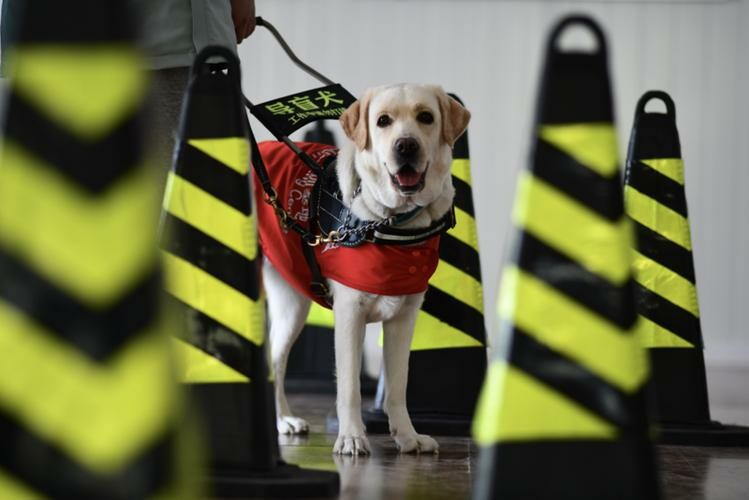
First, regarding breed selection, generally only Labradors, Golden Retrievers, and Poodles are chosen. Secondly, they need to undergo gene sequencing to trace back 3 generations for records free of aggression and genetic defects; they also cannot have intense curiosity or an overly lively personality. Once the dogs grow to 1 year old, they can leave their foster families. After that, they will begin strict training lasting over half a year, repeating the same training items tens of thousands of times until they form conditioned reflexes to obstacles. At the same time, the adopter must also come to the base and conduct joint training with the dog for at least 30 days.
Under this near-harsh screening, only 35 of the 107 dogs in training at the Dalian training base last year qualified. These 35 graduates have to bear all the expenses, so the cost is naturally driven up. If the delivery quantity were increased to 80 dogs, the cost could be compressed from 190,000 to 80,000 RMB. Unfortunately, there is a bottleneck in the training pass rate, and this is the biggest problem in the guide dog industry.
Although the Dalian Guide Dog Base claims that mature training technology can pull up the pass rate, even for an established base like Dalian, the pass rate is less than 40%, let alone other small agencies. Many agencies can only graduate a few dogs a year. Low pass rates caused by high standards are an inevitability of the guide dog training industry. Not only in China, but in Japan—the most developed country in Asia for guide dog training—the number of guide dogs has also been stagnant in recent years.

Regulatory Loopholes and the Problem of Fake Guide Dogs
Industry Standards and Certification
At this point, some students might ask: Since the training standards for guide dogs are so high, why are there still incidents of guide dogs urinating indiscriminately?
Actually, there are currently loopholes in China’s guide dog regulation. The only reference standard for domestic guide dog training is the “China Guide Dog Standard”which the Dalian Guide Dog Base helped draft in 2018. Logically speaking, local Disabled Persons’ Federations should issue work permits to dogs that pass tests according to this standard, and only dogs with work permits can officially go on duty as qualified guide dogs.
However, after looking into it, we found that some agencies can bypass the Disabled Persons’Federation’s review. According to staff at the Shanghai Disabled Persons’Federation, dogs certified by the Shanghai Disabled Persons’ Federation indeed have work permits issued by the Federation, but the Shanghai Disabled Persons’Federation has no knowledge of dogs from some operating units. We also asked the China Disabled Persons’ Federation if all guide dogs have permits issued by the Federation. As a result, the China Disabled Persons’Federation doesn’t even handle any inquiries regarding work permits. Upon our repeated questioning, they stated we should “provide feedback to superiors,” leaving us no choice but to file a petition.

Not only that, but there are also no relevant qualification reviews for similar private guide dog training companies in China, meaning anyone can open a training company. This also explains why guide dogs themselves are so scarce, yet in daily life, we more or less see or hear about guide dogs: many dogs with simple training or even no training, and without work permits issued by the Disabled Persons’ Federation, are disguised as guide dogs by people. Using public opinion for protection, they enter and exit public places freely. After all, buying a vest for a dog is much simpler than training one.
Seeing this, does everyone think guide dogs are a scam? I personally feel this cannot be called a scam, but it definitely has many problems: the guiding effect of guide dogs is undeniable, but at the same time, their high cost, scarcity, weak market regulation, and inadequate laws and regulations are also facts. And undeniably, as flesh-and-blood lives, guide dogs can never be replicated and mass-produced like machines.
Are Smart Guide Devices an Alternative?
Why Not Hire a Caretaker?
Then why should we fixate on high-cost guide dogs? Why not develop smart guide devices?
Didn’t many netizens say that smart guide devices can already replace guide dogs? Even if we don’t use guide devices, wouldn’t it be more cost-effective to use that 200,000 RMB to hire a person? If you gave that money to me, I’d definitely guide better than a guide dog. So I asked some blind friends; some are athletes, some are programmers, and some are massage therapists. The result of asking around was that everyone rejected these two options.
First, hiring someone to look after you is actually a very common preconceived misconception. Let’s put it this way: as an adult, having someone hovering around you 24 hours a day, where you have to call a caregiver first if you want to do anything: wouldn’t you find it annoying yourself?
Even if your parents hovered around you all day, you probably couldn’t stand it. Blind people also hope to gain independence and self-esteem, rather than being treated as a special group to be specially taken care of. Moreover, a guide dog costing 200,000 RMB can be used for about 8 years. Converted, that’s a wage of 25,000 RMB a year. Where can you hire a full-day caregiver that cheap?

Limitations of Smart Devices
As for smart guide devices, the results we got were even more unexpected. The interview subjects all used the most ordinary 4-section or 5-section canes. We tried contacting companies that make smart guide devices, looking for 5 companies one after another, and in the end, we learned that all of them had closed down. They told us without exception: there is no market for this thing, creating it results in a huge loss; secondly, this thing is really not as simple as everyone thinks.
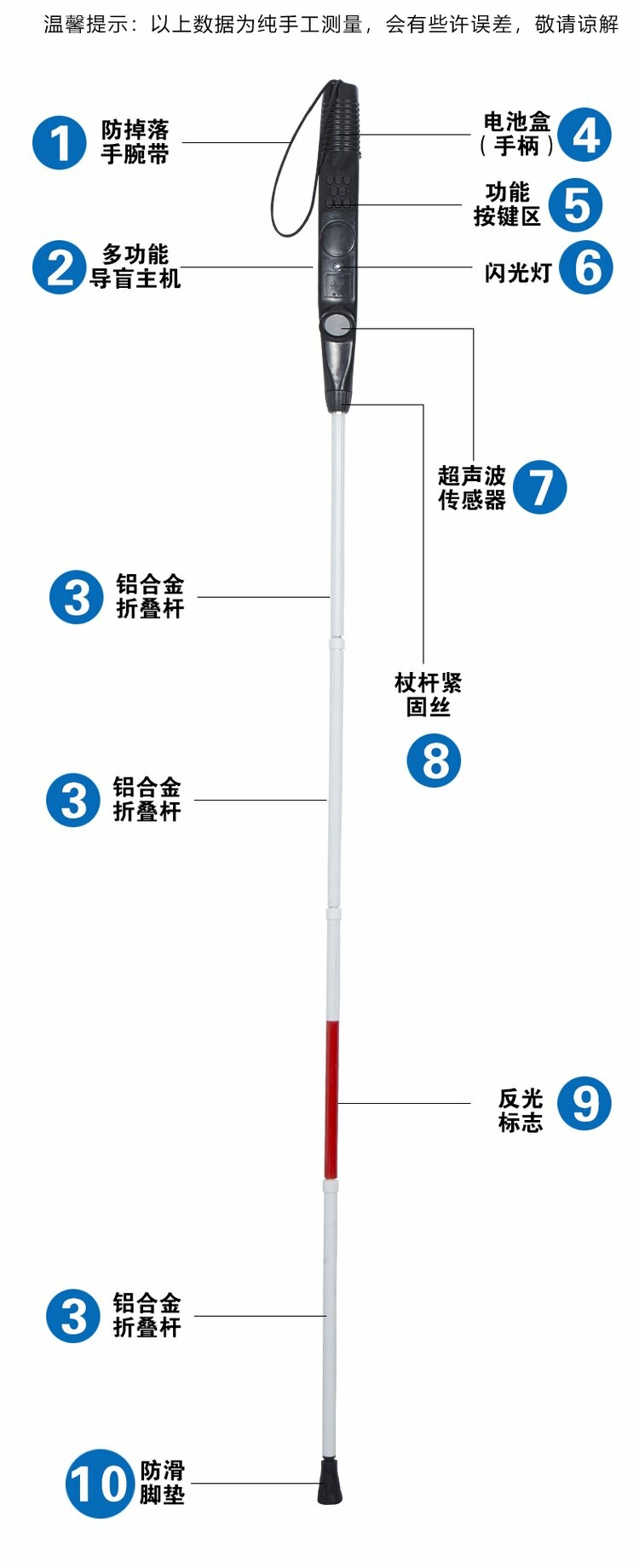
Mass-produced smart guide canes on the market generally have this effect; some products even print the Braille incorrectly. The limitations of other guide products that have raised millions in financing and won countless awards are also significant. For example, a product called See-Key (Shike) Smart Guide Glasses, priced at 19,000 RMB, received ten million in financing back in 2018. It uses cameras and radar to detect obstacles, providing feedback to the user through sound prompts, claiming an accuracy rate as high as 92%. The principle is somewhat like your car’s reversing radar: the closer the obstacle, the louder the alarm sound, to achieve the effect of alerting the blind person to avoid obstacles. This is also the method currently adopted by all smart guide obstacle avoidance systems.
It sounds quite practical at first listen, but if placed in a complex scene, how should the machine judge which obstacles on the road present a danger? If it cannot filter and judge obstacles, the blind person is like someone backing up frantically in a crowd. The most important point is that this type of abstract guiding method is unsuitable for blind people. What blind people need is not to know the distance between themselves and an obstacle, but something that can force them to stop or move forward. A blind friend described it to me, saying that using this kind of device is like carrying a person giving directions on your back; even if the person reminds you in time, you dare not walk fast. What I really need is someone to lead me by the hand.
Furthermore, regarding some guide glasses with object recognition functions that sell for seven or eight thousand yuan, which look practical at first glance, a blind friend mocked:
This is a stupid machine. I can just touch it to know what it is; do I need you to identify it?
Not to mention that machine recognition is limited in quantity and prone to errors. Low cost-performance ratio is the fundamental reason why guide devices cannot open up the market of 17 million people.

Trust and Safety Issues
Does a blind person’s travel rely entirely on guide devices, or on the judgment of others? Take traffic lights for example: when crossing an intersection, if the guide device prompts the blind person that the green light is ahead with no obstacles, then in the blind person’s world, they will unconditionally believe that it really is a green light ahead. The biggest worry that Guangrong, a blind programmer we interviewed, has about these radar detection devices is that it is hard to guarantee the program is free of bugs; and once a recognition bug appears, it is difficult for the blind person to discover it.
Although human walking speed is relatively slow, the travel conditions are even more complex than autonomous driving for cars: a stone on the ground, a step at a corner, a pedestrian appearing at an intersection—these are all potential dangers for blind people. A driver can take over the vehicle from autonomous driving, but a blind person can only obey the commands of these devices.
Future Possibilities and Conclusion
300 years ago, humanity welcomed the 1st Industrial Revolution. Amidst the scalding and surging steam, humanity entered the steam age it had never experienced before. Steamships and automobiles began to appear, and humans were replaced by “tin fellows” for the first time. Just as automobiles replaced horses, the guide industry should also welcome an industrial revolution of its own. We believe in the power of technology; perhaps one day in the future, we will be able to see a mechanical dog leading its owner across the road.
As for the guide dog industry, at the end of the conversation, the staff at the Dalian Guide Dog Base told me that the Dalian Guide Dog Base has been participating in research on smart guide devices and also hopes that one day technology can replace guide dogs. However, as long as there is one blind person applying for a guide dog, the Dalian Guide Dog Base will continue to operate. This blogger finds it hard to judge whether this persistence is reasonable, but what I do know is that neither current guide dogs nor smart guide devices are the optimal solution. In China, 30% of blind people almost never leave their homes. I think I don’t need to say much about what exactly is blocking their doorways. Rather than arguing here about which is more useful, we might as well fix the sidewalks for the blind first.
Original article by KPTer, if reproduced, please cite the source: https://www.kaipet.com/en/guide-dog-scam-godsend-blind-revealing-truth-200000-rmb-breeding-cost






Comments(1)
I found the ‘intelligent disobedience’ aspect of guide dogs truly remarkable. How do trainers instill such critical judgment and trust in them?