

In the natural world, animal body size often follows a universal pattern: males are larger than females. Lions, gorillas, and even most fish follow this rule. However, these few turtle species break the norm, displaying a unique "female-larger-than-male" phenomenon.
Size Differences in Crowned River Turtles

The female’s carapace can reach up to 65.3 cm, which is nearly more than three times the male’s 20.5 cm. The Crowned River Turtle (a species found in rivers of South Asia) provides the most intuitive example of sexual size dimorphism in turtles.
Significant Contrast in Giant South American River Turtles and Map Turtles
The difference exhibited by the Giant South American River Turtle is even more astounding; the female’s carapace can reach a maximum of 109 cm, while the male is only 55 cm, making the female almost twice the size of the male. The Giant South American River Turtle is mainly distributed in northern South America, living in the Orinoco and Amazon river basins; the female’s massive size helps the Giant South American River Turtle lay more and larger eggs.
In Map Turtles, this difference is also clearly present. The Barbour’s Map Turtle female has a maximum carapace of 32.7 cm, which is 2.5 times that of the male’s 13 cm; the False Map Turtle female is 27.7 cm, close to twice the male’s 15 cm. These two North American turtle species live in rivers and feed on mollusks. The larger body size of the females helps the Barbour’s Map Turtle and False Map Turtle better store energy to meet the energy demands of the breeding season.

Male Pattern in Alligator Snapping Turtles and Sulcata Tortoises
The Alligator Snapping Turtle and Suwannee Alligator Snapping Turtle display the opposite pattern. The male Alligator Snapping Turtle’s carapace reaches a maximum of 77.5 cm, exceeding the female’s 53.3 cm, and the male Suwannee Alligator Snapping Turtle even reaches 80 cm, while the female is only 49.2 cm.
This "male is larger" pattern is relatively rare among turtles and typically appears in species where there is direct competition between males or a need to guard territory.
The Sulcata Tortoise also follows this pattern; the male’s carapace can reach up to 101 cm, exceeding the female’s 67 cm. In this tortoise species native to Africa, the male gains an advantage in courtship competition through a larger body size.

Sexual Characteristics of Diamondback Terrapins and Roofed Turtles
The sexual size difference in Diamondback Terrapins is at a moderate level; the female carapace is a maximum of 32 cm, while the male is 18 cm, making the female about 1.8 times the size of the male. This turtle species from the East Coast of North America is famous for its beautiful shell patterns, and the larger size of the female may be related to the Diamondback Terrapin’s survival needs in salt marshes and bays.
The gender difference in Roofed Turtles is even more obvious. The Three-striped Roofed Turtle female at 56 cm is nearly twice the male’s 29 cm, the Brown Roofed Turtle female at 24 cm is close to twice the male’s 12.8 cm, and the Assam Roofed Turtle female at 21 cm is more than twice the male’s 9.8 cm.

For these turtles, primarily distributed in Southeast Asia, the larger body size of the female may help the Roofed Turtle maintain stability in turbulent environments and reserve enough energy for egg-laying.
Scientific Explanation for Larger Female Body Size
The demand for egg-laying is the primary reason for larger female body size; a larger body means a larger body cavity, which can accommodate more and larger eggs. Some studies indicate that female body size is positively correlated with the number of eggs per clutch.
More massive females are often able to lay more and larger eggs, which directly improves the survival rate of offspring. Larger eggs provide more nutrients for the development of hatchlings, making them larger and stronger upon hatching.
Ecological niche (referring to the status and role of a species in a biological community) differentiation also promotes sexual size dimorphism. In some turtle species, males and females actually occupy slightly different ecological niches, eating different types of food or foraging in different areas; this ecological separation allows the two sexes to evolve different body sizes.
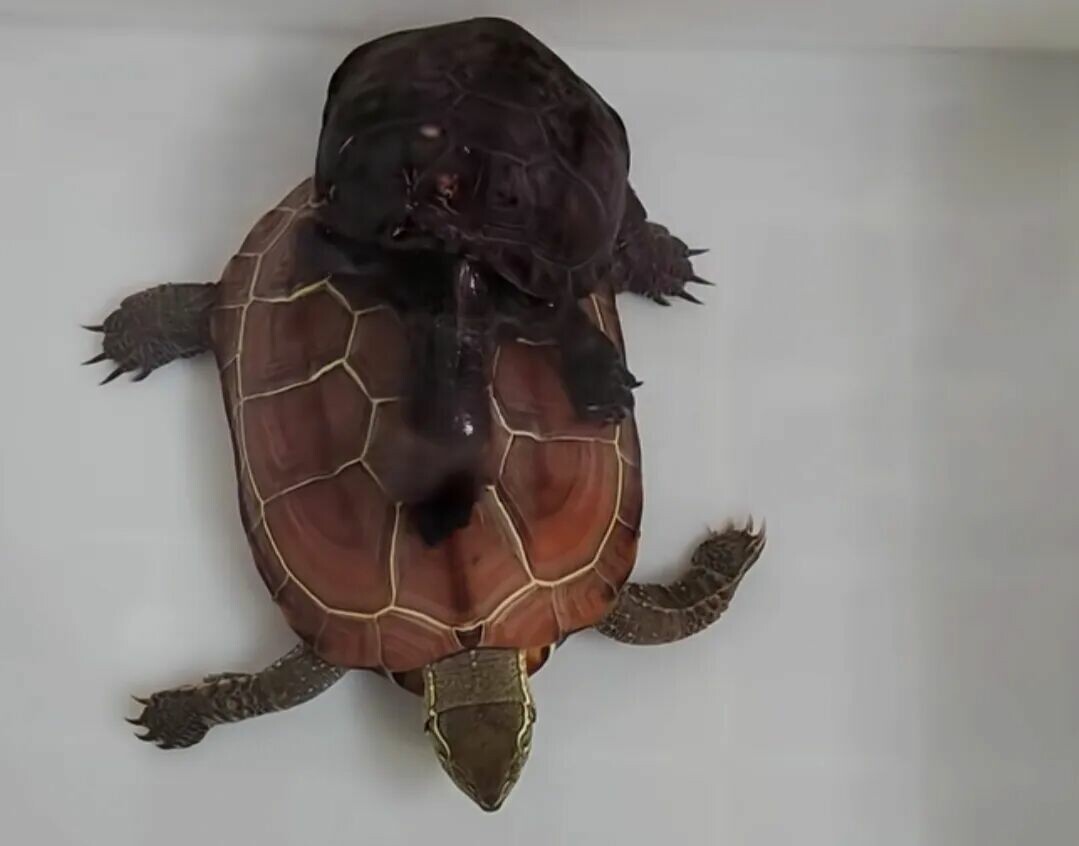
Energy storage needs also drive the increase in female body size. Reproduction is a huge energy consumption for female turtles; a larger body size means more fat reserves, enabling them to sustain survival and complete reproduction during food shortages.
Original article by 搬运工, if reproduced, please cite the source: https://www.kaipet.com/en/female-turtles-larger-males-revealing-10-turtle-species-massive-sexual-size-dimorphism






Comments(1)
This is super insightful! Beyond reproduction and niche, are there other environmental factors influencing female turtle size?