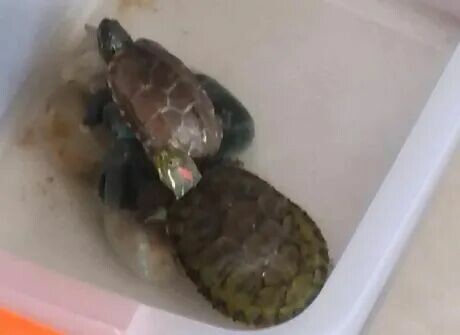
How to care for turtles at home with heating? There are three scenarios:
- The heating is quite warm, and the temperature difference between day and night is minimal. If the water temperature can reach 25 degrees Celsius (77 degrees Fahrenheit) or higher, that’s optimal. No additional measures are needed; you can maintain normal care as usual.
- The heating is not extremely warm but is consistent, with a small temperature variation. For instance, I live in an older community where the heating meets the minimum standards. While it’s cozy indoors, the water temperature only hovers around 18 to 20 degrees Celsius (64 to 68 degrees Fahrenheit). In such cases, you can use a heating rod to increase the water temperature to 25 to 28 degrees Celsius (77 to 82 degrees Fahrenheit) for normal care. Alternatively, you could forgo the heating rod altogether, but this is only advisable if you’re willing to control and reduce feedings to about once every two weeks.
- Despite the presence of heating, the temperature fluctuates significantly, with large differences between morning and evening, and sporadic temperature changes. This situation is more challenging and requires one of two extreme approaches: either use a heating rod to keep the turtle warm throughout the winter, in which case you should remove the basking platform and secure the tank lid to maintain internal temperatures, or place the turtle in a consistently cold location such as a windowsill or outdoors to encourage hibernation.
In summary, controlling the temperature difference is key. Heating or hibernation are the simplest and most hassle-free solutions. Any significant temperature fluctuations can lead to complications.
Original article by KPTer, if reproduced, please cite the source: https://www.kaipet.com/en/turtles-survive-winter-indoors-heating-common-scenarios-solutions
How Do Turtles Survive Winter Indoors with Heating? Three Common Scenarios and Solutions Part 03