


When we think of turtles, what comes to mind might be the sacred animals in temples, or perhaps the ‘wangba’ (soft-shell turtle) in the dish “Farewell My Concubine.” But you may not know that in the writings of the ancients, turtles had over 40 elegant alternative names, each one embodying the wisdom of our ancestors. Today, let’s explore the creative ways the ancients referred to them.
Names Based on Cultural Symbolism
In traditional culture, the turtle is a symbol of spirituality, longevity, and wisdom. This category of names is filled with reverence and respect, with many originating from mythological classics and sacrificial traditions.
Xuanwu (The Black Tortoise)
One of the Four Celestial Spirits of ancient China, corresponding to the northern direction, it is arguably the turtle’s most imposing name. Initially, Xuanwu was depicted merely as a large black turtle. After the Han Dynasty, it gradually evolved into a totem of an intertwined turtle and snake, becoming the Northern God revered in Taoism and often appearing on the eaves tiles and murals of ancient architecture.
Shen’gui (Divine Turtle)
The famous line from Cao Cao’s “Though the Tortoise Lives Long,”which reads, “Though the divine turtle is long-lived, its time must one day end,”made this name widely known. *Zhuangzi: The Floods of Autumn* even records, “In Chu, there was a divine turtle that had been dead for 3,000 years.” Legend has it that it could carry heaven and earth on its back and knew all things past and present, making it the ultimate symbol of auspiciousness and longevity.
Ling’gui (Spirit Turtle)
Hailed as the “embodiment of the wise,” it was believed to understand human nature and predict fortune and misfortune. It frequently appears in Chinese mythology and was also the most revered spiritual creature in ancient divination, regarded as a symbol of prophets.
Yuan’gui (Primal Turtle)
This term specifically refers to giant turtles, which were often used in major sacrificial rites and divination activities in ancient times. It was also one of the “Four Ranks of Tortoise Treasures,” a currency from the era of Wang Mang. Later, it was also used by analogy to refer to past events that could serve as a lesson or to exceptionally intelligent strategists.
Yu’ling / Yu’ling Fuzi (Jade Spirit / Master Jade Spirit)
In the *Records of the Grand Historian: Biographies of Turtle and Yarrow Stalk Diviners*, the divine turtle is called “Yu’ling.”The addition of “Fuzi”(an honorific for a master or scholar) adds an air of scholarly elegance, consistent with its cultural positioning as a “wise one.”The Tang Dynasty poet Wei Yingwu also mentioned it in a poem: “The Jade Spirit ripples, gliding over clear waves.”
Lingcai / Dacai (Spirit Cai / Great Cai)
“Cai” was originally the name of a place in ancient times that produced large turtles. Later, it was used to directly refer to the large turtles used for divination. In the poems of Emperor Jianwen of the Southern Dynasties and Yuan Zhen of the Tang Dynasty, “Shen’cai” (divine Cai) was used to refer to turtles, highlighting their efficacious nature in divination.
Jin’gui / Jin’jie (Golden Turtle / Golden Armor)
The character “Jin” (gold) conveys auspicious wishes for wealth and long life, while “Jin’jie”(golden armor) gets its name from the turtle’s hard shell. One expresses meaning, the other describes form, both showcasing the naming ingenuity of the ancients.
Ming’ling / Cang’liu (Nether Spirit / Hider of Six)
“Ming’ling”originates from an ancient term for long-lived turtles, which were said to live for thousands of years. “Cang’liu” (hider of six) vividly reflects the turtle’s habit of retracting its head, tail, and four limbs into its shell when encountering enemies, alluding to the wisdom of “hiding in six places.”
Names Based on Descriptive Features
This category of names either derives from the turtle’s appearance and habits or from the playful banter of scholars. They are lively and down-to-earth, fully displaying the meticulous observation of the ancients.
Wangba
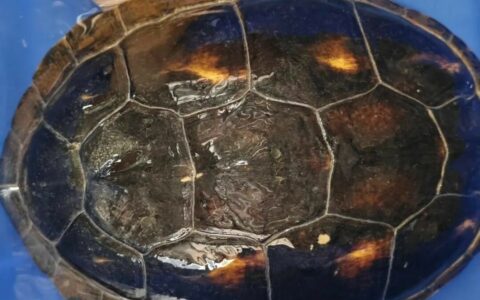
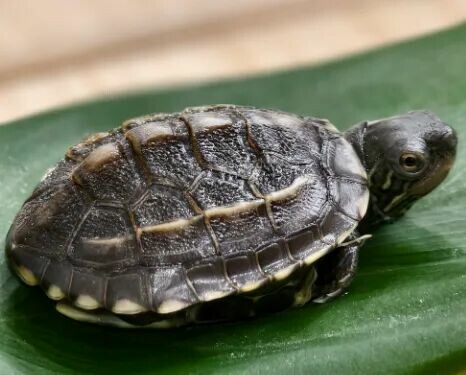
The most widely known common name, its origin is surprisingly related to the patterns on the turtle’s plastron (belly shell)! The central pattern on a turtle’s plastron resembles the character “王 ” (wáng), while the patterns at the head and tail ends resemble the character “八 ” (bā). Whether viewed from the belly towards the head or the tail, one can make out the two characters “王八 ” (wángbā), thus giving rise to this amusing name.
Ziyi Dafu (Grand Master in Black Robes)
“Ziyi” refers to black clothing. The turtle earned this name because its carapace is dark and shiny, resembling a Grand Master (an ancient official) dressed in black embroidered garments.
In the Jin Dynasty, Sun Hui wrote in his “Rhapsody on the Words of a Turtle,” “There is a Grand Master in black robes, clad in black embroidered garments,” comparing the turtle to an erudite and refined official, full of admiration.
Xuanyi Dúyou / Xuanjie Qing (Black-Robed Supervisor / Minister of Black Armor)
“Xuanyi” means black clothes, “Dúyou” was an ancient official title for an inspector who oversaw counties and investigated illegal activities, and “Qing” was an honorific for a person of high rank. Both the *Gujin Zhu* by Cui Bao of the Jin Dynasty and the *Compendium of Materia Medica* by Li Shizhen of the Ming Dynasty record these two names, likening the turtle to an official dressed in black, which carries a quaint, classical charm.
Tōngyōu Bóshì / Tōnglíng Bóshì (Doctor of the Netherworld / Doctor of Spirit Communion)
Turtles are relatively intelligent and have extremely long lifespans. The ancients believed they could communicate with the netherworld and perceive fortune and misfortune, so they bestowed these two “academic titles” upon them, implicitly praising their spiritual nature.
Xiānzhī Jūn (Lord Seer)
Ge Hong of the Jin Dynasty recorded in *Baopuzi*, “What can be called the Lord Seer’s brain, some say is the turtle.”
Tang Dynasty texts also mention, “The turtle is called the Lord Seer,” directly pointing to the ancient belief that turtles could foresee the future.
Sìrì Shíjūn (Lord of the Si Hour)
This name originates from the Theory of Animal Correspondences in Ge Hong’s *Baopuzi* from the Eastern Jin Dynasty (a theory that associated certain animals with specific times, directions, etc.). The book states, “That which is called the Lord of the Hour is the turtle.”Since “Si” in the Twelve Earthly Branches corresponds to the snake, and turtles and snakes were often mentioned together in ancient times, this name came to be.
Lòu Tiānjī (Leaker of Heavenly Secrets)
This is a name recorded by Li Shizhen in the *Compendium of Materia Medica*, meaning that the turtle can leak the secrets of heaven, which alludes to its function in divination and predicting fortune and misfortune.
Yuanxu / Yuanzhu
These are names full of classical elegance. “Yuanxu” comes from a story in the Southern Dynasties’*Yiyuan* (A Garden of Marvels) where “a tree calls a turtle Yuanxu,”and later scholars often used it to refer to turtles. “Yuanzhu” was the term for a turtle shell in the Wu-Yue region, as seen in the *Taiping Yulan* (Imperial Readings of the Taiping Era), which quotes the *Records of Nanyue*.
Niche and Elegant Names
In addition to the common alternative names, ancient scholars also created many niche, elegant names for the turtle, which became embellishments in their poetry and prose.
Dòngxuán Xiānsheng (Master of Profound Mysteries)
As recorded by the Qing Dynasty scholar Li Quan in his *Shiwu Yiming Lu* (Record of Alternative Names for Things), the turtle, being able to reveal fortune and misfortune through pyromancy, was granted the title “Master of Profound Mysteries,” which has a “Taoist immortal aura.” Similar names include “Master of Primal Mysteries” and “Knower of the Profound,” all highlighting its spiritual characteristics.
Tuólóng / Dàyuán / Yuányuán (Camel Dragon / Great Yuan / Round Yuan)
These names were derived from the turtle’s appearance, with its carapace raised like a camel’s hump and its body being round and blunt. “Yuan” (a type of large freshwater turtle, commonly known as the Chinese soft-shelled turtle) is originally a large soft-shelled turtle, but in ancient times it was often mentioned alongside turtles, becoming one of their alternative names.
Yīnchónglǎo / Dìjiǎ / Jiāngshǐ (Old Yin Insect / Earth Armor / River Emissary)
“Old Yin Insect” gets its name from the turtle’s preference for shade (yin) and its long life. “Earth Armor”highlights its feature of being covered in a shell, resembling armor. “River Emissary”originates from a myth in the *Records of the Grand Historian* where a divine turtle acts as the “emissary of the river” on a mission to the Yellow River.
These alternative names not only enrich the connotations of the language but also show us the affection and reverence the ancients had for the turtle—it was no longer just an animal, but a cultural symbol carrying beautiful meanings such as longevity, wisdom, and auspiciousness.
Original article by 搬运工, if reproduced, please cite the source: https://www.kaipet.com/en/wangba-forty-elegant-names-turtles-cultural-significance-ancient-china








Comments(2)
Truly insightful! I’m amazed by the rich cultural symbolism and many elegant names for turtles. Which one resonated with you most?
@CriticX:Thank you, CriticX, for your wonderful feedback! We’re delighted you enjoyed the article. For me, ‘Ling’gui’ (Spirit Turtle) particularly resonates, symbolizing wisdom and prophecy, which beautifully captures the reverence for turtles in ancient culture.