

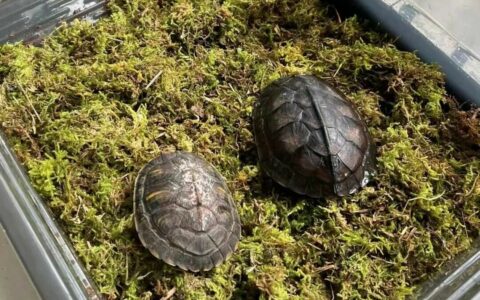
For many highly aquatic (living in water) turtle species, they tend to hibernate at the bottom of the water without specifically seeking a particular environment. When the temperature in the wild drops below freezing, the lake surface freezes, isolating the turtles hibernating at the lake bottom from direct contact with the air. Although turtles rely on lungs to breathe, they can still survive while hibernating underwater.
Oxygen Needs and Accessory Respiration
Turtles indeed need oxygen when hibernating. Turtles at the bottom of a lake reduce their demand for oxygen by lowering their metabolic rate; their heart rate is extremely low, and the body’s demand for oxygen is only 10%-20% of normal conditions. Additionally, they possess an accessory respiratory system:
- Cutaneous respiration (Skin breathing): The skin of some deep-water turtles has special capillary structures capable of absorbing dissolved oxygen from the water.
- Pharyngeal mucosa (Mucosa of the inner lining of the throat) respiration: The mucous membrane inside a turtle’s throat can directly exchange gases with oxygen in the water.
- Anal sac (Sac-like structure inside the cloacal wall) respiration: The anal sacs and accessory bladders (auxiliary bladders of the cloaca) on the inner wall of the cloaca (the common cavity for excretion and reproduction) are used for gas exchange. Although the efficiency is lower, it is sufficient to maintain life activities during hibernation.
At the same time, water in low-temperature environments has a higher oxygen content, which is beneficial for turtles to obtain oxygen through accessory respiratory organs.
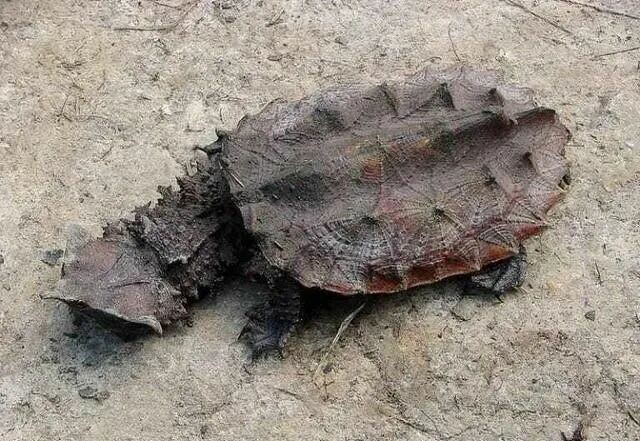
Differences in Hibernation Capabilities
It is worth noting that although some turtles can hibernate underwater, not all turtles possess this ability. Some aquatic turtles usually climb ashore to dig pits for hibernation, which may be related to the climate of their place of origin and their habits.
These behaviors reflect the different survival strategies endowed to turtles by nature.
Care Tips for Non-Hibernation Periods
However, this is limited to the time of hibernation; at this time, the turtle’s consumption is very low, so it can use a small amount of oxygen. Usually, when the turtle is still active, it must surface regularly to exchange air; the trace amount of oxygen at this time cannot support the turtle’s physical exertion. Therefore, our usual resting platform (a platform for aquatic turtles to rest and bask in the sun) is still very important.
It is only in the case of hibernation that one should not fret needlessly; just set your mind at ease.
Original article by 搬运工, if reproduced, please cite the source: https://www.kaipet.com/en/dont-turtles-drown-hibernating-underwater-revealing-accessory-respiratory-organs



Comments(1)
Fascinating! Which aquatic turtle species specifically hibernate on land, rather than using these amazing underwater methods?