

A common saying goes, “A workman must first sharpen his tools if he is to do his work well.”
What is the most basic requirement for keeping fish?
That’s right, a fish tank!
But there are many types of fish tanks. How should you choose one?
Below, we will discuss this from 2 different aspects.
Aquarium Selection: The Fish’s Environmental Requirements
Water Quality Management
Stocking Density
The larger the body of water, the more stable the water quality, and the easier it is for fish to survive. However, not every space is suitable for a large aquarium. Moreover, even with a large tank, overstocking with too many fish is equally detrimental to their survival.

The definition of frequent, small-volume water changes is: a water change frequency of more than once a week, with the amount of water changed not exceeding 1/3 of the total volume.
But how do we know if the stocking density is too high?
You can make a simple observation. Start by keeping a small number of fish and slowly increase the quantity. If you notice that the water in the tank gets dirty easily, becomes cloudy, or fish start to die or jump out of the tank, it indicates that the stocking density has reached its critical point. At this time, you must begin to manage the number of fish in the tank. These standards will vary depending on the size of the fish and the dimensions of the tank.
The table below provides examples of the basic space required for different sizes and quantities of fish (based on a standard-sized fish tank).
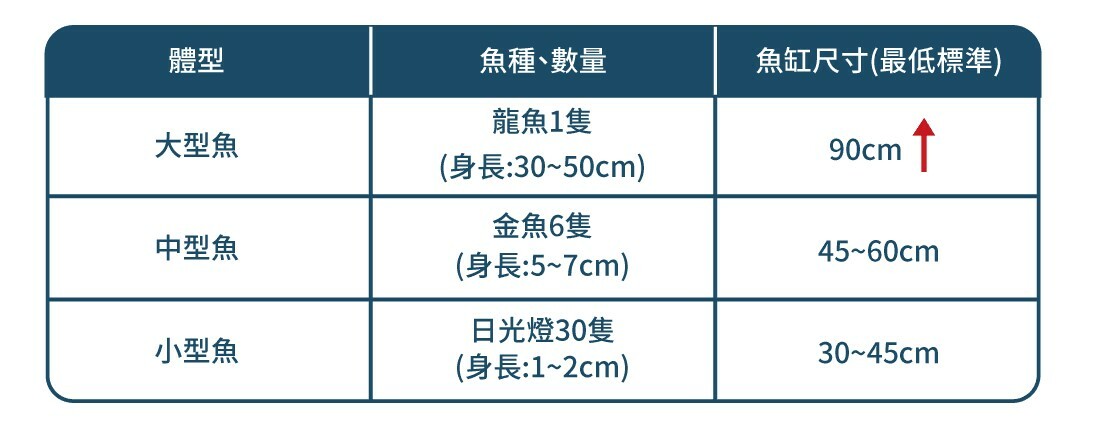
Additionally, the tank dimensions must be greater than the water volume required by the fish to provide a better living environment.
Calculation method for water volume required by fish:
Tank Length x Tank Width x Water Level Height (cm) / 1000 = Water Volume Required by Fish (L)
The Fish’s Diet and Excretion
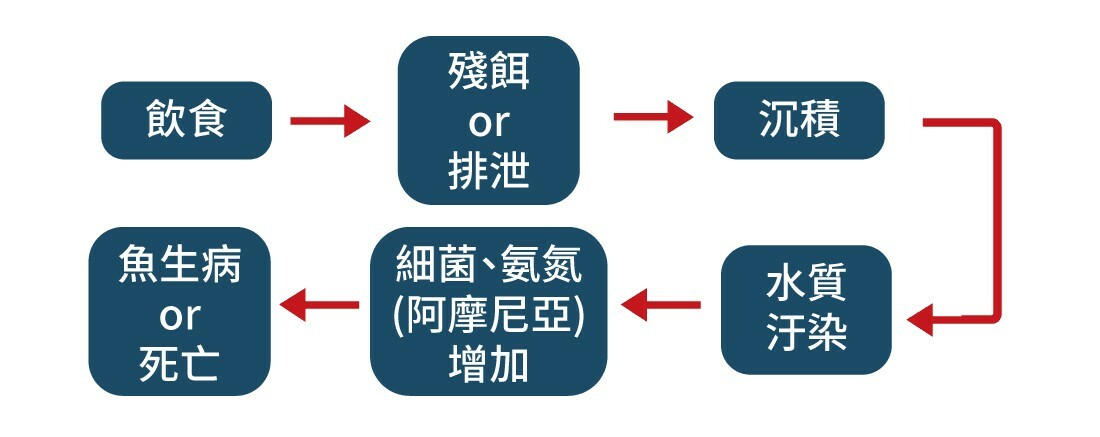
All living organisms need to obtain energy through eating, and wherever there is eating, there will be excretion. If waste is not cleaned up in time, or if the filter is not powerful enough, the water quality in the tank will be affected. The level of pollution varies depending on the fish’s diet, and the quality of the food also affects how well the fish absorb and utilize it.

- Carnivorous: Feed on smaller fish, shrimp, and insects. Since meat is primarily protein-based, it tends to lower the water’s pH value, leading to water acidification. Therefore, it causes a high level of water pollution.
- Herbivorous: Feed on fruits, aquatic plants, and algae, causing a low level of pollution.
- Omnivorous: Eat anything that can fit into their mouths, whether carnivorous or herbivorous. The pollution level varies depending on the food consumed at the time and is relatively higher than that of herbivores.
In addition, some fish species produce more waste, which can also pollute the water more easily, requiring more frequent water changes and enhanced filtration equipment. Besides waste, leftover food is also generated during each feeding, which is another cause of water pollution.
The Fish’s Activity Space
Different species of fish have different habits and require different amounts of activity space. You cannot judge the required space based solely on the fish’s body size.
- Some like to call friends and swim in schools, such as Neon tetras.
- Some are master athletes, dashing around recklessly, such as Zebra danios and Electric Yellow Cichlids.
- Some fish are aggressive and solitary, such as Arowanas and Flowerhorn cichlids.
- Some are as still as an old monk in deep meditation, remaining motionless, such as Corydoras and Plecos.
- And some like to gather in groups but swim slowly, such as Angelfish and Congo tetras.
Therefore, regardless of whether the fish are large or small, you need to provide enough space for them to move freely according to their habits. If the activity space is insufficient, the fish will also feel bored and become melancholy.
The above are the basic needs of fish regarding their living space and environment. Before setting up a tank, you need to consider all these habits comprehensively to match them with the right type of aquarium, ensuring the fish can live happily and freely!
Original article by 搬运工, if reproduced, please cite the source: https://www.kaipet.com/en/beginners-guide-choosing-fish-tank-essential-tank-selection-methods-novices
Comments(2)
I found the stocking density section really helpful! Beyond just observing, what are some early warning signs you look for to prevent overstocking?
@CriticX:We’re glad you found the stocking density section useful! That’s a great question about proactive prevention. Beyond visible changes, keep an eye on fish behavior like increased aggression or lethargy. Also, more frequent ammonia/nitrite spikes in water tests can be crucial early indicators of potential overstocking. Regular water parameter monitoring is key!