

Some turtle enthusiasts, when raising turtles, often choose transparent glass tanks as homes for their turtles. A transparent tank is not only aesthetically pleasing but also allows the owner to observe the turtle’s activities at any time, greatly increasing the aesthetic value. Isn’t that a good thing? However, are transparent tanks really suitable for turtles? Many turtle enthusiasts have raised doubts.
In fact, transparent tanks can bring a lot of stress and health risks to turtles, and such issues have always been discussed among turtle enthusiasts. Are transparent tanks really unsuitable for keeping turtles? Actually, we see that many bloggers (referring to people who write blog posts or publish other content on online platforms) and enthusiasts do use transparent tanks to raise turtles. Naturally, there are disadvantages, but it’s up to us, as keepers, to mitigate them for the turtles.
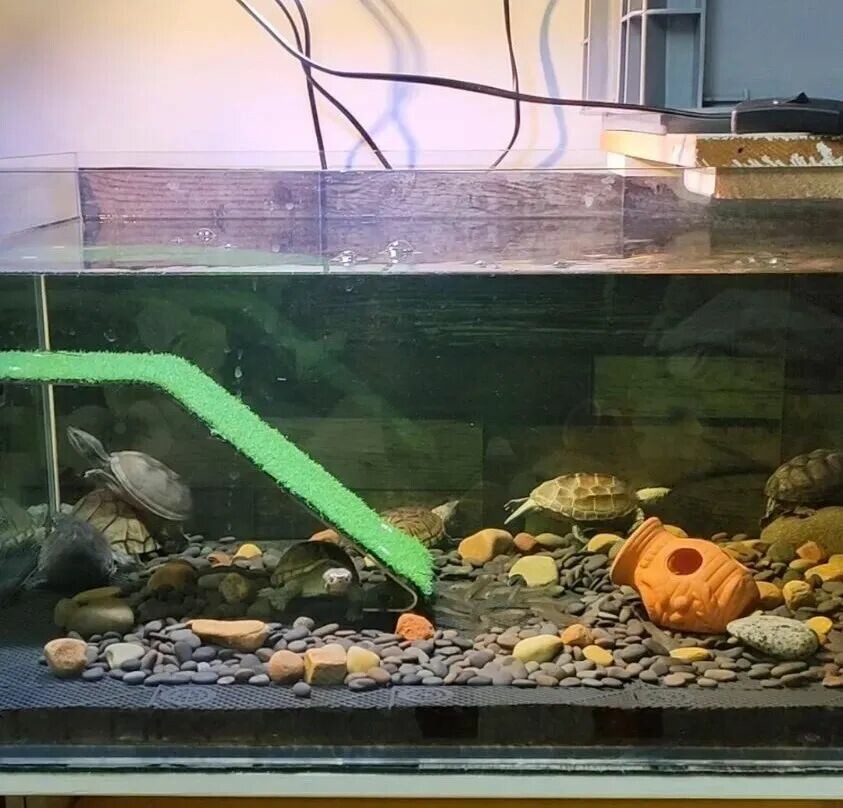
The Turtle’s “Nearsightedness”and “Iron-Headed Kid” Nature
Turtles do not have very good eyesight; they are “nearsighted” and lack the ability to recognize transparent objects. When a turtle moves around in a transparent tank, the clear glass they see is like a sparklingly clean window to us. The turtle might mistake the front for open space and ram into it in a moment of excitement. The turtle might get dizzy from the impact, and it could even cause a concussion.
Improvement Suggestion: If you must use a transparent tank, you can apply opaque background paper or frosted film to the inner walls of the tank to reduce the turtle’s misjudgment of the clear glass. Additionally, adding some hiding spots (like rocks, driftwood (referring to wood that has been submerged for a long time, formed through decay and mineralization, often used in aquascaping), or aquatic plants) can also help the turtle better perceive the environmental boundaries.
Forced “Socially Anxious Streaking”: Turtles Need Privacy Too
Imagine if you were locked in a transparent display case 24 hours a day, with your eating, drinking, and relieving yourself all being watched. Wouldn’t you feel anxious? Turtles are the same. Although they are cold-blooded animals, they also have their own emotions and needs. Being exposed to a transparent environment for a long time will make a turtle feel extremely insecure and may even lead to them refusing to eat (referring to the act of an animal refusing to eat), acting erratically (referring to losing emotional control and behaving abnormally), or attacking their tank mates. This is also one of the reasons why transparent tanks can easily cause stress (referring to a series of non-specific responses of an organism to external stimuli) in turtles during the initial stages.
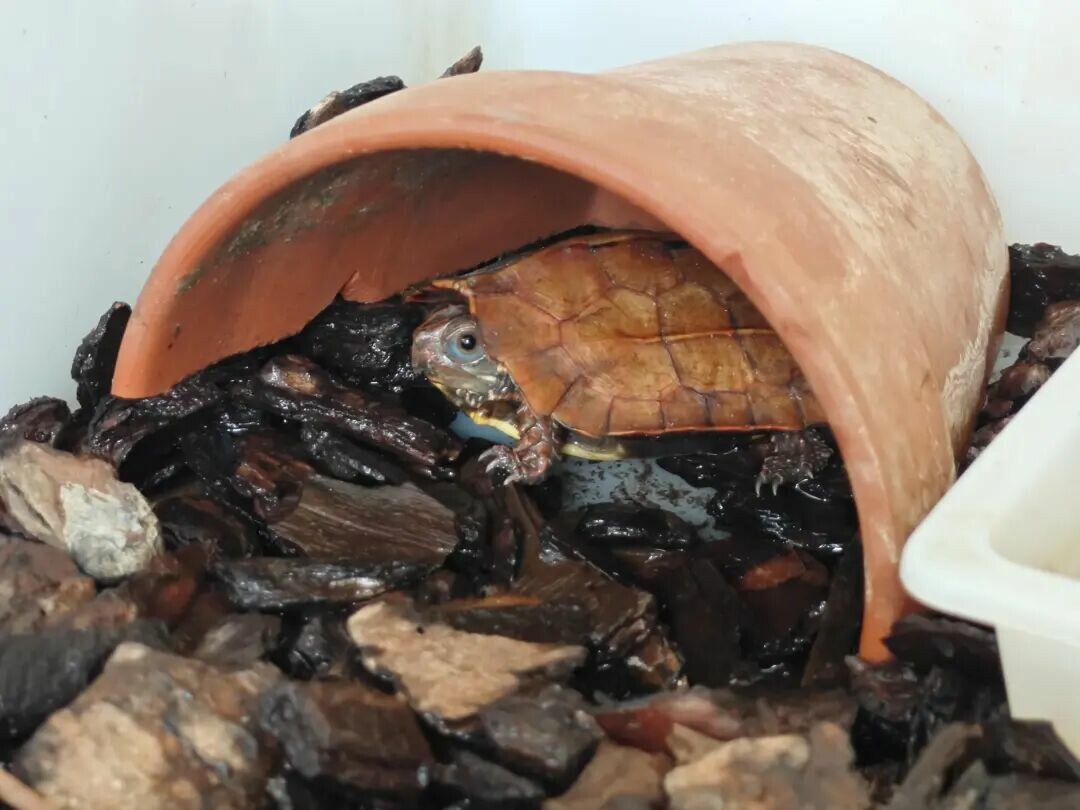
Improvement Suggestion: Set up hiding spots in the tank, such as caves, driftwood, or aquatic plants, to provide the turtle with a place to hide. This will not only alleviate the turtle’s anxiety but also make them feel secure. There’s nothing a good hiding spot can’t solve.
The Despair of Being Trapped in a “Ghost Wall”
Another problem with transparent tanks is that they can make a turtle fall into the philosophical dilemma of “Who am I? Where am I?” When the tank is 360 degrees transparent, the turtle will feel lost, as if trapped in a space without boundaries. This environment can make the turtle feel extremely insecure and may even cause them to be in a prolonged state of stress.
Improvement Suggestion: Besides setting up hiding spots inside the tank, you can also place some opaque decorations outside the tank to help the turtle better perceive the environmental boundaries. For example, you can place a wooden board or a piece of cardboard against one side of the tank to reduce the sense of transparency. Of course, round transparent tanks are not recommended. Firstly, the turtle’s perspective will be distorted and curved, and secondly, it is genuinely difficult to grasp the boundaries, and the space is also greatly compressed. If using a transparent glass tank, it should be a square one.
The Trap of the “Beginner’s Happy Tank”
To attract novice turtle enthusiasts, many merchants promote so-called “transparent tank kits.” These tanks usually have water levels so low you can only soak your feet, small basking platforms, and no filtration (referring to the filtration system used in an aquarium to purify water quality) or temperature control equipment (referring to equipment used to regulate and maintain a specific temperature), nor are they convenient for adding your own. Such an environment not only fails to meet the basic needs of the turtle but can also cause serious harm to their health.
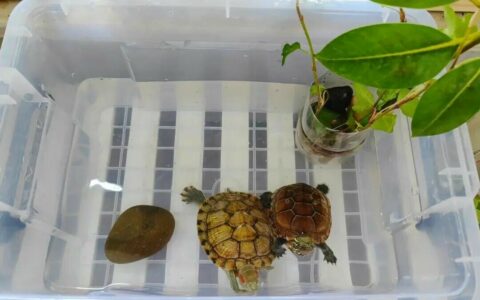
Improvement Suggestion: Choose a suitable container for raising turtles, such as a storage tote (a type of plastic box used for circulating and storing goods), a highly transparent storage container, or just a glass tank. Ensure the water level is deep enough, the basking platform is large enough, and it can be equipped with filtration and temperature control equipment. You don’t have to use this equipment, but the space should be reserved for it. The vast majority of “beginner’s happy tanks” are not very practical; this editor has also fallen into this trap before.
Although transparent tanks may look beautiful, they are not well-suited to the living habits of turtles. What turtles need is an environment with a sense of boundary and privacy, not a “glass palace” that makes them feel anxious and insecure. By adding hiding spots, improving the tank’s transparency, and choosing suitable keeping equipment, we can create a more comfortable and healthier living environment for our turtles. This way, your transparent environment can become a good setup that integrates both aesthetics and proper husbandry.
Raising a turtle is not just a pleasure, but also a responsibility. I hope every turtle enthusiast can care for their beloved turtle with their heart, allowing them to grow up healthy and happy!
Original article by 搬运工, if reproduced, please cite the source: https://www.kaipet.com/en/harmful-transparent-tanks-turtles-unveiling-4-major-risks-improvement-methods-read-beginners


Comments(1)
This is such a comprehensive guide! I’m curious, for those who use transparent tanks, what creative and effective ways have you found to add privacy or boundaries for your turtles?