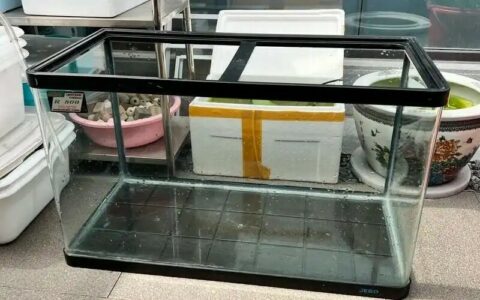
You were initially planning to start with a small aquarium for fun, but someone suggested going for a larger one, which might have caused some confusion. In fact, there’s no need to be overly concerned. Let me tell you, whether it’s a small or large tank, they should not be chosen carelessly.
Issues with Small Tanks
Generally speaking, tanks under forty centimeters can be considered small. The downside of small tanks is that they can accommodate fewer types of fish. As a beginner, when you first start keeping fish, you’ll naturally want to buy various kinds of fish, right? However, keeping fish at high density in a small tank will inevitably lead to rapid water quality deterioration and fish deaths.
Issues with Large Tanks
What about large tanks? You should avoid those as well. What constitutes a large tank? Generally, tanks over 60 centimeters in length are considered large. Indeed, large tanks have many advantages; at least they have a large water capacity, can accommodate many fish, and the fish are not prone to dying. However, they also have quite a few disadvantages:
- The aquarium is large, occupying a significant amount of space.
- The cost of equipment required for a large aquarium is higher.
- Water changes and cleaning the aquarium are very troublesome.
- If you are only impulsively interested in keeping fish, and after a while, you no longer wish to keep them, how would you deal with the aquarium?

Recommended Aquarium Sizes
Reading this far, you might feel even more confused. So, I recommend three sizes for you: the first is a 30-centimeter square tank, the second is a 40-centimeter rectangular tank, and the third is a 60-centimeter rectangular tank. I will explain the advantages and disadvantages of each one by one. This way, choosing one among the three will be much easier.
30-Centimeter Tank
The 30-centimeter square tank has a larger volume than a 40-centimeter long rectangular tank. A 30-centimeter square tank can hold twenty-seven liters of water, while a 40-centimeter long rectangular tank can only hold twenty-four liters. Its advantages are threefold: good viewing effect, simple aquascaping, and easy photography.
40-Centimeter Tank
Compared to the 30-centimeter tank, the 40-centimeter tank offers more flexibility in aquascaping. You can place a main landscape in the center of the tank and leave enough space on both sides to balance the visual effect, or choose to lay out a main landscape on one side and leave the other side blank to create an asymmetrical aesthetic. This layout not only adds visual depth but also provides more swimming space for fish.
60-Centimeter Tank
If you are the type of person who likes to buy fish, you are most likely destined to buy various kinds of fish. In this case, choosing a sixty-centimeter aquarium is a good choice. The aquascaping of a sixty-centimeter tank can be seen as an enlarged version of a forty-centimeter tank, and its water capacity is also double that of a forty-centimeter tank, which can basically meet the needs of beginners for purchasing various fish.
A Small Tip
If you plan to lay substrate sand in a sixty-centimeter aquarium, it is recommended to choose a tank with a height of thirty-five centimeters. Since the substrate sand is about five centimeters thick, and considering that the water level should not be too full, after removing this centimeter, the remaining water depth is about twenty-five centimeters, which is just right for viewing. However, try to avoid choosing aquariums that are too tall, as it would be inconvenient to reach in and maintain them.
Original article by KPTer, if reproduced, please cite the source: https://www.kaipet.com/en/beginners-choose-aquarium-size-recommendations-3-aquarium-sizes