

In recent years, with the prosperity of the pet market, turtles have become one of the popular pets, attracting a large number of consumers. However, the chaos of the turtle market is something everyone is somewhat aware of. Confusing phenomena have gradually appeared in the market: some Yellow Pond Turtles (a common freshwater turtle, often called “Little Green”) show an unnatural yellow color after purchase, and even details such as claws, leg pockets, and neck folds turn unusually yellow.
Behind these “Yellow” Gold Turtles, if you were to question it, the merchants would say:
This is caused by our supplementation of multivitamins (a supplement containing various vitamins), not “Chemical Trickery” (an internet slang term referring to the use of improper or excessive artificial intervention to achieve a certain effect).
So, would this happen if we soaked them in multivitamins ourselves? Besides, why is it always the Yellow Pond Turtles (“Little Greens”)? Why don’t Chinese Pond Turtles (Reeves’ Turtles, a common pet turtle), Mud and Musk Turtles (a collective term for various turtles with round or oval shells, known as “Egg Turtles”), or Red-eared Sliders (known as “Brazilian Faces”, a common pet turtle) have this? Do they not deserve multivitamins? Or do multivitamins only change based on the turtle’s mainstream color?
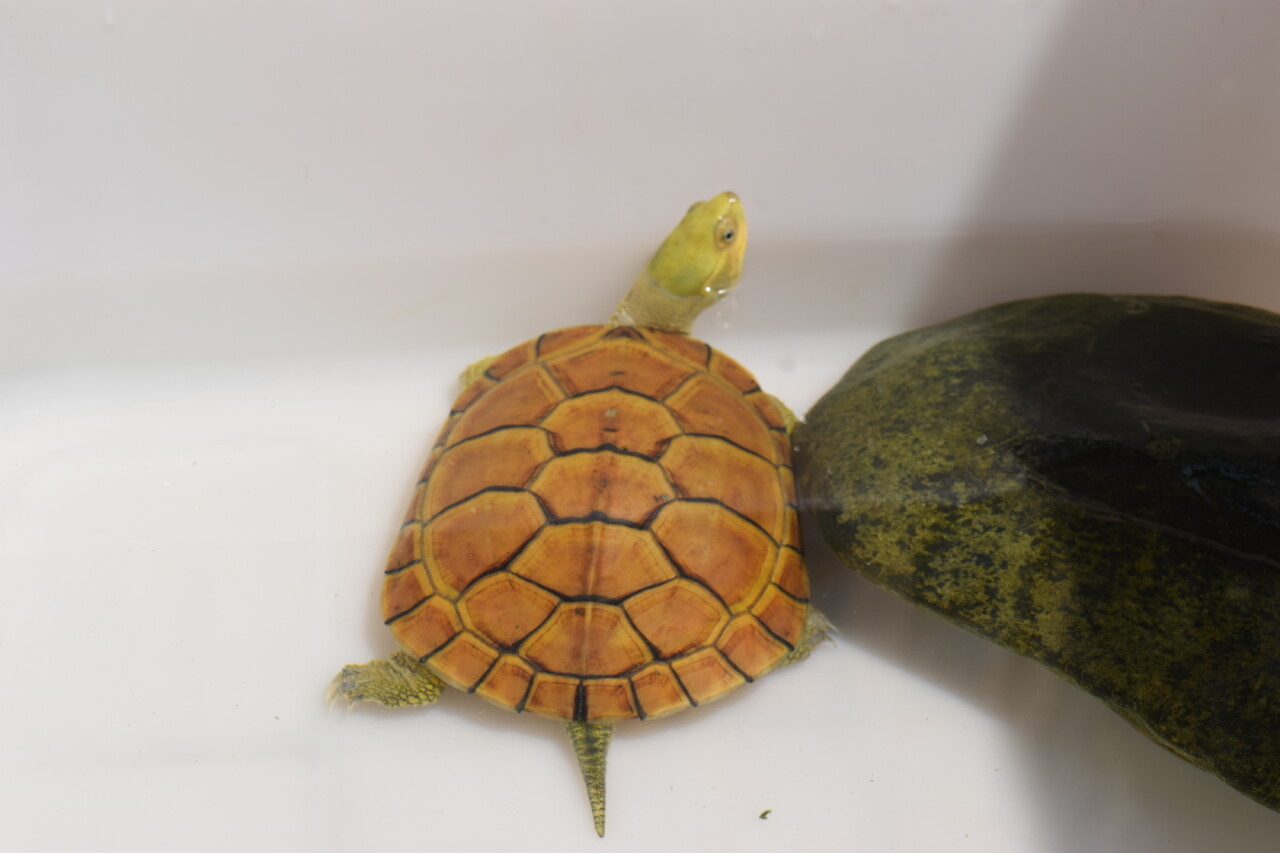
Turtles Under “Chemical Trickery”: Is the Survival Rate High?
First, we need to clarify whether the use of “Chemical Trickery” has improved the turtle’s survival rate. Merchants claim that by supplementing energy through methods like “soaking in multivitamins,” the goal is to make the turtles healthier and more energetic. However, the reality may not be so.
Impact of Chemical Substances: If merchants used certain chemical substances (such as dyes, drugs, etc.) to alter the turtle’s appearance, these substances may have a negative impact on the turtle’s health. Long-term exposure to these chemicals may damage the turtle’s immune system and digestive system, actually lowering the survival rate.
Stress Response: During transport and breeding, if turtles frequently come into contact with unknown substances, they may generate a stress response, leading to problems such as loss of appetite and lowered immunity, which in turn affects their survival rate.
Natural Growth vs. Artificial Intervention: Naturally grown turtles, although perhaps not as brightly colored as “Tech Turtles,” usually have more stable health conditions. Turtles subjected to artificial intervention may look “prettier” in the short term, but in the long run, their health condition and survival rate may not be better than naturally grown turtles.
The Trust Crisis Between Turtle Dealers and Consumers
When consumers discover that the turtles they purchased show an unnatural yellow color and question whether the merchants used “Chemical Trickery,” merchants often explain it away as “energy supplementation.” However, this explanation cannot completely eliminate consumer doubts.
Information Asymmetry. Consumers lack professional knowledge and find it difficult to judge whether what the merchants say is true or false. This information asymmetry leads to consumer distrust of merchants.
Integrity Issues. If merchants indeed use improper means to alter the turtle’s appearance, this behavior not only harms consumer interests but also destroys the market’s integrity system. Over time, consumer trust in the turtle market will drop significantly.
So now it feels like merchants and consumers are increasingly opposed, with no trust to speak of. Personally, I feel this is not a good thing. It might also be caused by the general atmosphere of “having a conscience means making no money.”
The Long-term Impact of “Chemical Trickery” on the Turtle Market
The use of “Chemical Trickery” may bring certain economic benefits to merchants in the short term, but in the long run, this behavior does more harm than good to the development of the turtle market.
As consumer trust in the turtle market declines, market demand may gradually shrink. Especially for those enthusiasts who care about pet health and natural growth, they may choose other, more transparent pet markets.
If certain merchants are widely questioned by consumers for using “Chemical Trickery,” the brand image of the entire turtle market may be implicated. Consumers may develop a negative impression of the whole industry, thereby affecting the long-term development of the turtle market.
For the development of the turtle market, integrity, transparency, and natural growth are the keys to sustainable development. As enthusiasts, when purchasing turtles, we should focus more on their health condition and natural appearance, rather than being confused by superficial “beauty.” I estimate that future merchants will have to compete not just on price and volume, but also on after-sales service and the quality of the turtles.
Original article by 搬运工, if reproduced, please cite the source: https://www.kaipet.com/en/abnormal-yellowing-green-turtles-uncovering-shady-dyeing-tactics-turtle-market




Comments(1)
Important topic! I wonder, how can we as a community help promote ethical practices and transparency to protect turtles and buyers?