Pet owners have heard the expression “three cats and four dogs”, which, like the human pregnancy, literally means that cats give birth to kittens after three months of pregnancy and dogs give birth to puppies after four months of pregnancy. However, this is not the case, and kittens do not stay in their mother’s womb for that long, from conception to birth.

How many months of pregnancy does a cat give birth?
Pet owners can figure out when their cat is expected to give birth by counting from the first day of mating. Generally speaking, the gestation period for female cats is 61-67 days, with the average being 65 days.
After the male cat and the female cat “clap for love”, if conception is successful, the female cat will give birth naturally within 58-67 days. If this period is exceeded, the survival rate of the kittens will be affected.
Owners can determine if a cat is pregnant by observing the cat’s breasts for about 20 days after mating to see if they have become larger and if the hair in the ring around them has fallen out.
During pregnancy, the mother cat’s food intake will increase, so during this time, pet owners must remember to properly supplement their cat’s diet! For example, canned cat food should be given as a diet in addition to the regular diet, but the intake should be controlled and the cat should not be given too much. Especially if the cat is young and small, it will be difficult for the cat to give birth if the fetus is too large!

What are the symptoms of prenatal labor in cats?
Before giving birth, most female cats will appear to be looking for a litter, irritable and yowling. If the cat is not satisfied with the maternity room you prepared for her, she will look for a new one again. When pus-yellow discharge comes out of the cat’s vaginal opening, the cat will usually give birth within 1 – 2 hours.
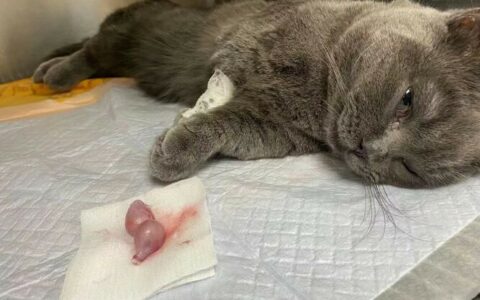
Many pet owners want to help do something when their cat is in labor, but in fact the cat doesn’t need it at all. The only thing you can do is to prepare plenty of water and canned food for the cat when it is in labor, help the cat to replenish its strength, and patiently observe the cat on the side to see if there is any difficult labor. In addition, if the mother cat gives birth to kittens and does not bite the umbilical cord herself, the pet owner then needs to help the kittens cut the umbilical cord at the first time.

How do I give first aid to a newborn kitten?
A newborn kitten may choke on amniotic fluid, causing it to fall into a coma right after birth. At this time, the pet owner should accurately determine whether the kitten was born without breath or just unconscious. Generally speaking, when the kitten is completely dead, the body will be cold, there is no heartbeat, and the mouth will ooze liquid when it is closed; while the body temperature of the kitten in a coma will slowly drop, and there is still a way to save the kitten at this point.
It is recommended that the pet owner put the unconscious kitten into 40-45 degrees of warm water at the first time, keep rubbing the body of the kitten, you can also hold the cat’s head and body, gently flinging it down to shake the amniotic fluid out of the cat’s mouth, and at the same time, gently pressing the heart of the kitten, to help the kitten recover. If the kitten starts to move, then it is saved; but if it does not move for 2-3 minutes, then it is basically hopeless.

Postpartum care for female cats
Maintain a warm and quiet living environment
Pet owners must make sure that the cat’s maternity ward is quiet and warm, and try not to disturb the mother cat. This is because after the mother cat has just given birth to her cubs, if she feels that her surroundings are unsafe, she will move her kittens to a secluded place, and some cats may even eat them due to the stress of the outside environment.
Supplementation for female cats
Generally, the mother cat will start eating within 24 hours after delivery, and the cat food can be used for pregnant cats or kittens, while not restricting water intake. During the first week after delivery, the mother cat will spend most of her time in the incubator and even if she leaves, it will be for a short period of time. Therefore, the litter box, food and water bowls should be placed not far from the birth box, which will allow the mother cat to be more assured of food and water.
About artificial feeding
If the mother cat does not want to take care of the kittens, or if there is not enough milk, the owner will have to take care of the kittens by artificial feeding. It is recommended that pet owners mix goat’s milk powder in warm water, put it in a bottle and feed it to the kitten. Never give the kitten milk! There are many cats that lack the enzymes in their intestines to digest and absorb milk, and drinking milk can lead to indigestion and diarrhea!
Original article by KPTer, if reproduced, please cite the source: https://www.kaipet.com/en/cat-pregnancy-birth-care-guide-essential-knowledge-professional-pet-owners